William D. Gauldin & Tabitha Ann Burnett

William D. Gauldin, born around 1817 in Pittsylvania County, Virginia, was the son of Thomas Gauldin and Peggy Walker, members of two long‑established families in the Callands–Whitmell region. He grew up in a rural farming community where literacy was rare and life revolved around seasonal labor, kinship ties, and modest agricultural holdings. Tabitha Ann Burnett, born about 1834 in Callands, came from one of Pittsylvania’s oldest and most documented families. She was the daughter of Edward Burnett (1757–1850) and Mariah “Mary” Burnett (1812–1870), and the granddaughter of Benjamin “of Piscataway” Burnett Sr. and Frances “Fanny” Barnett, early settlers whose descendants spread widely across the county. Her step‑brother was Barksdale “Buz” Burnett, a familiar figure in Burnett genealogies.
By 1850, sixteen‑year‑old Tabitha was living in a small household with older Burnett relatives—Mary Burnett, age 85, and Susan Burnett, age 40—along with Edward Burnett, age 55, likely her father. She was recorded as unable to read or write, a common circumstance for rural girls in antebellum Pittsylvania, where domestic labor took precedence over formal schooling.
On 22 April 1860, Tabitha married William D. Gauldin in Pittsylvania County, with the ceremony performed by Rev. M. W. Read. William worked as a farm hand, owned a small personal estate valued at $15, and—like Tabitha—was unable to read or write.
When the Civil War began, William enlisted in the 38th Virginia Infantry (Pittsylvania Regiment), serving as a Private in Company K. (1) His service records appear under variant spellings—Gauldin, Gaulden, Golding—typical of Confederate paperwork.
38th Virginia Infantry (Pittsylvania Regiment), Company K
The 38th Virginia Infantry, often called the Pittsylvania Regiment, was formed in June 1861 at the beginning of the Civil War. It drew heavily from Pittsylvania County, with additional companies from neighboring counties. Company K was one of its Pittsylvania companies, composed almost entirely of local farmers, laborers, and tradesmen—men who lived within a few miles of each other, worked the same land, and shared deep community ties.
Company K mustered into Confederate service under the command of officers such as Capt. William T. Townes and later Capt. James T. Walton. The regiment was assigned to Brigadier General Lewis A. Armistead’s Brigade, part of Pickett’s Division in the Army of Northern Virginia. Throughout 1861–1862, the regiment served in southeastern Virginia, performing guard duty, picket duty, and participating in early Peninsula Campaign actions. Disease was rampant in these early camps, and many men suffered long-term health effects before ever seeing major combat.
The 38th Virginia fought in nearly every major engagement of the Army of Northern Virginia:
Seven Pines (May 1862)
Seven Days Battles (June–July 1862)
Antietam Campaign (September 1862)
Fredericksburg (December 1862)
Suffolk Campaign (Spring 1863)
But the regiment is best remembered for its role in Pickett’s Charge at Gettysburg on July 3, 1863. This was the battle that defined the regiment’s legacy. Several men from Company K were killed or captured here, and many never returned home. If William Gauldin was at Gettysburg, he was there when his cousin Jabez S. Gaulding was killed. If he was captured after that battle then he spent two years as a prisoner, but the records do not give any information about when or where he was captured.
Near the end of the war, he was imprisoned at Amaillia, Arkansas, and released on 27 June 1865, returning home to Pittsylvania County after the Confederacy’s collapse.


The above record gives the following information:
Name Wm Golding
Rank Private
Record Type: Release
Arrival Date: 5 Apr 1865
Imprisonment Place: Amaillia Ark
Side of War: Confederate
Company: K
Regiment: 38 Va
Release Date: 27 Jun 1865
The Prison at Point Lookout, Maryland
Point Lookout, Maryland was one of the largest and most notorious Union prison camps of the Civil War, and yes—there absolutely was a prison there. It operated from 1863 to 1865, holding tens of thousands of Confederate prisoners, including many from Virginia regiments like the 38th Virginia Infantry, the unit in which William D. Gauldin served.
Point Lookout, located at the southern tip of Maryland where the Potomac River meets the Chesapeake Bay, began the Civil War not as a prison but as a fashionable seaside resort. By 1859 it boasted a hotel, wharf, and over a hundred cottages. When war broke out, the U.S. government leased the property and converted it into Hammond General Hospital, completed in 1863 to treat Union soldiers arriving by ship. (3)
After the Battle of Gettysburg in July 1863, the federal government established a massive prisoner‑of‑war camp adjacent to the hospital. Point Lookout quickly became the largest Union prison camp, designed for 10,000 men but eventually holding over 20,000 prisoners at a time. Conditions deteriorated rapidly: prisoners lived in worn tents rather than barracks, food was scarce, clothing inadequate, and disease rampant. By June 1864, more than 20,000 men were crowded into roughly 1,000 square feet of camp space, and an estimated 4,000 of the 50,000 total prisoners who passed through Point Lookout died there. (4)
The camp’s geography made escape nearly impossible. Surrounded on three sides by water, with Union cannons at Fort Lincoln and naval guns offshore, only about 50 escapes were ever successful. Before the war, the area had strong Southern sympathies, which heightened tensions between guards and prisoners—especially after U.S. Colored Troops were stationed there. Prisoners endured extreme weather: icy winds in winter, blistering heat in summer, and frequent flooding that left tents knee‑deep in mud. Rations were minimal, often leading to scurvy and malnutrition. Accounts describe prisoners eating rats, raw fish, and even a washed‑ashore seagull in desperation. Clothing was scarce; some men had no shoes, and blankets were shared among a dozen or more. Disease—especially chronic diarrhea—was widespread and deadly.
Point Lookout’s history is preserved today through letters, diaries, photographs, and official documents from both Union and Confederate soldiers. These records reveal a stark picture of overcrowding, suffering, and survival in one of the Civil War’s harshest prison environments. Although William’s release record lists Amaillia, Arkansas, Confederate soldiers from the 38th Virginia Infantry were frequently captured and sent to Point Lookout, and many of their compiled service records show imprisonment there. The conditions he endured—malnutrition, exposure, disease, and overcrowding—were typical of Point Lookout’s environment. His release on 27 June 1865 fits the timeline of mass prisoner releases after the Confederacy’s surrender.

In this pension application, Tabitha Gaulding states that she was a resident of the area near Danville in Pittsylvania County, Virginia. She was the widow of William Gaulding who was a member of Company _ 38 Virginia Regiment and that he died "about 3 years ago, near Brosville in Pittsylvania County, from dropsy." She and William Gaulding were married at Pigg's Mill in about 1860. She had not married again. This application was signed 11 May 1900. She didn't give any more information about his military service.
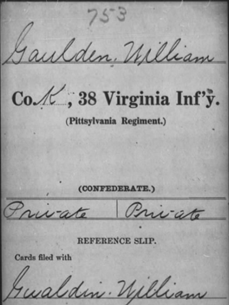
Service Record (6)
US, Civil War Service Records (CMSR) - Confederate - Virginia, 1861-1865; Thirty-eighth Infantry (Pittsylvania Regiment)
Gaulden, William
Military Unit: Thirty-eighth Infantry (Pittsylvania Regiment)
Conflict Period: Civil War (Confederate)
Branch: Confederate Army
Served For: Confederate States
Roll Name: 0843
After the War
By 1880 (1), William and Tabitha were living together in Callands, where William—age 63—was listed simply as a farmer, and Tabitha—age 46—was recorded as a housekeeper. Their household consisted only of the two of them, suggesting that he and Tabitha had no children together. Both continued to be listed as unable to read or write, consistent with earlier records.
William died in 1897, near Brosville, Pittsylvania County. His widow’s Confederate pension application, filed on 11 May 1900, confirms his death. After William’s death, Tabitha lived as a widow in the Tunstall District of Pittsylvania County. The 1900 census lists her—age 59—living with the Serapia family, likely working as a housekeeper or residing with neighbors or relatives who provided support in her later years. She remained unable to read or write but could speak English.
Together, William D. Gauldin and Tabitha Ann Burnett represent the intertwined histories of two longstanding Pittsylvania families. Their lives were shaped by rural labor, limited resources, and the upheaval of the Civil War. Though they left few records beyond census entries, military documents, and a widow’s pension application, the surviving evidence preserves the outline of a life lived entirely within the agricultural communities of Callands, Whitmell, and Brosville. Their legacy continued through William’s children from earlier relationships and through the extended Gauldin and Burnett families who remained prominent in the region.
Works Cited
1. U.S., Civil War Soldiers, 1861-1865 . ancestry.com. [Online] https://www.ancestry.com/search/collections/1138/records/5251190?tid=163174124&pid=422121230467&ssrc=pt.
2. U.S., Civil War Prisoner of War Records, 1861-1865. ancestry.com. [Online] Maryland: Point Lookout, Military Prison, v. 356: Prisoner registers, 1863-1865. https://www.ancestry.com/imageviewer/collections/1124/images/M598_114-0213?pId=700177.
3. Point Lookout Civil War collection. University of Maryland: Archival Collections. [Online] https://archives.lib.umd.edu/repositories/2/resources/1405?utm_source=copilot.com.
4. Point Lookout Prisoner of War Camp. National Park Service. [Online] https://www.nps.gov/pohe/learn/historyculture/point-lookout-prisoner-of-war-camp.htm.
5. Alabama, Texas and Virginia, U.S., Confederate Pensions, 1884-1958. ancestry.com. [Online] Virginia, Act of 1900 Pension Applications, Pittsylvania County (surnames A - L). https://www.ancestry.com/imageviewer/collections/1677/images/31867_b034285-00226?pId=1058162.
6. US Civil War Service Records. Fold 3. [Online] William Gaulding. https://www.fold3.com/image/13484549/gaulden-william-page-1-us-civil-war-service-records-cmsr-confederate-virginia-1861-1865?xid=6794.
7. 1880 United States Federal Census. ancestry.com. [Online] Virginia, Pittsylvania, Callands. https://www.ancestry.com/imageviewer/collections/6742/images/4244682-00682?pId=42859225.
© 2026 Catherine L. Gauldin, Gaulding Origins. All original content protected. Use of this site implies agreement with the Terms of Use and Privacy Policy.


Comments