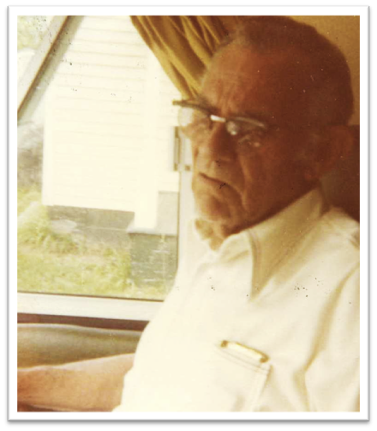
Ned Merriman Gauldin served on board the U.S.S. Intrepid

Ned Merriman Gauldin was the middle child of Thomas Arthur Gauldin and Ruby Adair Merriman Gauldin. He was born 23 May 1925 in Rockingham County, North Carolina, grew up in the textile‑mill communities of the Piedmont and moved with his family between Leaksville and Fieldale as his parents followed mill work. By the early 1940s he was living in Henry County, Virginia, attending school while his parents worked in the cotton mills. Like many young men of his generation, Ned came of age during World War II, and the global conflict shaped the direction of his early adulthood.
On 31 May 1944, at nineteen, Ned enlisted in the U.S. Navy. He served as a Fire Controlman Third Class (Temporary) aboard the USS Intrepid (CV‑11), one of the most active aircraft carriers in the Pacific Theater. Muster rolls place him aboard the Intrepid through at least January 1946, meaning he served during the final phases of the war and into the early postwar period. His service on a front‑line carrier placed him among the thousands of young sailors whose wartime experiences defined the trajectory of their lives. (1)

Ned Merriman Gauldin entered active duty in the U.S. Navy on 2 September 1943, as shown by his official service number 83559923. His military record explicitly lists his Active Duty Branch as the U.S. Navy and his Active Duty Unit as USS Intrepid, confirming that he served aboard the Essex‑class aircraft carrier during World War II. Navy muster rolls and his service file place him on the Intrepid throughout the war’s final years.
He remained on active duty until 19 March 1946, when he was formally discharged. His later 1948 draft registration further verifies his wartime service, noting his prior registration with Local Board #1 in Martinez, Virginia for World War II and listing the Intrepid as his active-duty assignment. Together, these records provide direct documentary proof that Ned Gauldin served in the U.S. Navy from 1943 to 1946 and that he was a crew member aboard the USS Intrepid during World War II. (3)
It is known that Ned Gauldin was on the Intrepid because his name appears on the Crew Muster Roll of December 31, 1944. On that date the USS Intrepid was operating in the Philippines, engaged in fast‑carrier strikes that supported the liberation of Luzon and the broader Philippine campaign. After completing major operations in the Palaus in September and participating in the Battle of Leyte Gulf in October, Intrepid moved with her task group into the waters off Mindanao and the Visayan Sea, conducting repeated raids on Japanese airfields and naval positions throughout September–December 1944.
By late December, Intrepid was still part of the Fast Carrier Task Force (TF‑38), positioned east of the Philippines and continuing air operations against Japanese bases as the U.S. prepared for the January 1945 invasion of Luzon. While the sources do not list her exact coordinates on that specific day, all available operational records place her in Philippine waters, actively engaged in the final phase of the 1944 carrier offensive. (4)
The U.S.S. Intrepid
USS Intrepid (CV‑11), the third Essex‑class aircraft carrier built for the U.S. Navy, entered service in August 1943 and was quickly sent to the Pacific. There it joined the Allies’ island‑hopping campaign, fighting in major operations including the Battle of Leyte Gulf and the invasion of Okinawa. During World War II, Intrepid survived a Japanese torpedo strike and three separate kamikaze attacks. After the war, the carrier served briefly with occupation forces before being decommissioned in 1947. (3)

Timeline of the USS Intrepid (CV‑11) (4)
April 26 1943 – Launched at Newport News Shipbuilding, Virginia; sponsored by Mrs. John Howard Hoover.
On April 26, 1943, the USS Intrepid (CV‑11) was launched at Newport News Shipbuilding & Dry Dock Company in Newport News, Virginia. The ceremony marked the birth of the fourth ship to bear the name Intrepid and one of the new Essex‑class aircraft carriers designed to expand the U.S. Navy’s striking power during World War II. The ship’s sponsor was Mrs. John Howard Hoover, wife of Rear Admiral Hoover, who christened the vessel as it slid down the ways into the James River. The launch was a major milestone in wartime shipbuilding—part of the Navy’s rapid expansion to meet the demands of the Pacific campaign. Following outfitting and sea trials, Intrepid was commissioned on August 16, 1943, under the command of Captain Thomas L. Sprague, beginning a distinguished career that would carry her through some of the fiercest battles of the Pacific Theater. (6)
December 3 1943 – February 1944 – Completed training, departed Norfolk, and joined Pacific operations. Took part in the Marshall Islands campaign, striking Roi and Namur.
After completing her shakedown training in the Caribbean, USS Intrepid (CV‑11) departed Norfolk on December 3, 1943, beginning her first wartime deployment. She sailed to San Francisco and then onward to Hawaii, arriving at Pearl Harbor on January 10, 1944. There she prepared for her first major combat assignment: the Marshall Islands campaign, a key step in the U.S. Navy’s island‑hopping strategy across the Pacific. On January 16, Intrepid sortied from Pearl Harbor with USS Cabot and USS Essex to strike Japanese positions at the northeastern corner of Kwajalein Atoll. Beginning January 29, her air groups launched continuous attacks on Roi and Namur, destroying all 83 Japanese aircraft stationed there before U.S. Marines landed on January 31. Intrepid’s planes strafed Ennuebing Island until minutes before the Marines hit the beaches, helping secure the island and opening the North Pass into Kwajalein Lagoon. By February 2, organized resistance had collapsed, marking Intrepid’s successful combat debut. With the Marshall Islands secured, Intrepid immediately moved on to her next target: Truk, Japan’s heavily fortified naval base in Micronesia. On February 17, she joined three fast‑carrier groups in a surprise raid that sank two destroyers and 200,000 tons of merchant shipping, demonstrating Truk’s vulnerability and diminishing its value as a Japanese stronghold. That same night, Intrepid was struck by an aerial torpedo that jammed her rudder and flooded multiple compartments. Through improvised seamanship—including a makeshift sail crafted from hatch covers and canvas—her crew kept the ship under control and brought her safely into Pearl Harbor on February 24, 1944 for repairs. (7)
June 1944 – February 1945 – Returned to combat; participated in raids on the Palaus, Philippines, Okinawa, and Formosa.
After completing repairs at Hunter’s Point in March 1944, USS Intrepid returned to front‑line combat that June, rejoining the fast‑carrier forces driving across the Central Pacific. Over the next eight months she took part in a relentless series of operations that broke apart Japan’s outer defenses and cleared the way for the liberation of the Philippines and the assault on Okinawa. In September, her air groups struck the Palaus, hitting airfields and artillery on Peleliu in support of the Marine landings. Within days she moved west to attack Mindanao, then swept through the Visayan Sea, destroying Japanese bases and supply routes. Intrepid returned to Peleliu on September 17 to support Marines still fighting through caves and mangrove swamps, then shifted back to the Philippines, Formosa, and Okinawa, hammering Japanese airfields that threatened the upcoming invasion of Leyte. (8)
October 1944 – Fought in the Battle of Leyte Gulf, helping sink the battleship Musashi and damaging Yamato.
Her most decisive actions came during the Battle of Leyte Gulf in October 1944, the largest naval battle of World War II. On October 24, Intrepid’s aircraft helped sink the battleship Musashi and damaged Yamato, Nagato, Haruna, and cruiser Myoko. The next day, at Cape Engaño, her planes helped sink carriers Zuihō and Chitose, and contributed to the destruction of Zuikaku, the last surviving carrier from the Pearl Harbor strike force. Despite two severe kamikaze attacks on October 30 and November 25, Intrepid remained operational and continued launching strikes until ordered home. She reached San Francisco on December 20 for repairs, and by mid‑February 1945 was back at sea, heading for Ulithi to prepare for the next phase of the Pacific war. (9)

USS Intrepid (CV‑11) crewmembers clear wreckage from the hangar deck after the carrier was struck by a Japanese kamikaze off the Philippines on 25 November 1944. (Official U.S. Navy photograph 80‑G‑270840) (6)
March – April 1945 – Rejoined the fleet; struck Kyushu and Okinawa; damaged again by a kamikaze on April 16.
By March 1945, USS Intrepid had returned to the Pacific in fighting condition and rejoined the fast‑carrier forces preparing for the final assaults on Japan. After arriving at Ulithi on March 13, she moved with the fleet toward the Japanese home islands. On March 18, her aircraft struck airfields on Kyushu, where a twin‑engine “Betty” bomber broke through defensive fire and exploded just off her forward boat crane, showering the ship with flaming debris. Quick work by her damage‑control teams extinguished the fires before they could spread. Intrepid then joined attacks on remnants of the Japanese fleet at Kure, damaging numerous vessels including the battleship Yamato and the carrier Amagi, before turning south toward Okinawa. As the invasion began on April 1, her air groups flew continuous support missions, hitting enemy positions across the island and neutralizing nearby Japanese airfields. On April 16, during a fierce air raid, a kamikaze smashed through her flight deck, killing eight men and wounding twenty‑one. Despite the destruction, her crew extinguished the fires within an hour, and flight operations resumed just three hours later—an example of the resilience that defined the carrier throughout the war.
August 15 1945 – Received orders to cease offensive operations; supported the occupation of Japan.
By mid‑August 1945, USS Intrepid was still operating in the Central Pacific, having just completed strikes on Wake Island during her westward voyage. On August 15, 1945, while at Eniwetok, she received the historic order to “cease offensive operations” following Japan’s decision to surrender. With the fighting over, Intrepid shifted immediately from combat duty to the new mission of supporting the occupation of Japan. She got underway on August 21 to join the occupation forces, helping stabilize the region and assist in postwar operations as American naval power moved into Japanese waters. Later that year, she departed Yokosuka on December 2 and arrived at San Pedro, California, on December 15, 1945, marking the end of her World War II service and the beginning of her transition into postwar status.
March 22 1947 – Decommissioned and placed in the Pacific Reserve Fleet.
By early 1946, USS Intrepid had completed her World War II service and shifted into a reduced operational status. After returning to the United States and operating briefly in San Francisco Bay, her activity steadily wound down as the Navy began demobilizing its massive wartime fleet. On August 15, 1946, her status was formally reduced to “in commission in reserve,” meaning she remained a Navy ship but was no longer fully active. On March 22, 1947, Intrepid was officially decommissioned and assigned to the Pacific Reserve Fleet, where she was laid up alongside other wartime carriers awaiting future decisions about modernization or disposal. This marked the end of her first career as a World War II combat carrier—one distinguished by major operations from the Marshall Islands to Okinawa—and the beginning of a five‑year period in reserve before her eventual Cold War recommissioning in 1952. (11)
Post–World War II History of USS Intrepid (CV‑11 / CVA‑11 / CVS‑11)
1952–1954 — Recommissioned, Modernized, and Reclassified as CVA‑11
On February 9, 1952, Intrepid was recommissioned to serve in the Cold War fleet. She underwent a major modernization that included an angled flight deck, updated arresting gear, and—most notably—American‑built steam catapults, making her the first U.S. carrier to launch aircraft using this technology. By October 1954, she emerged as CVA‑11, a modernized attack carrier capable of operating the Navy’s newest jet aircraft.
1955–1957 — Mediterranean Service and Operation Strikeback
From 1955 to 1957, Intrepid served with the U.S. Sixth Fleet in the Mediterranean, projecting American naval power during a tense period of the Cold War. In 1957, she took part in Operation Strikeback, a massive NATO naval exercise designed to test Western defenses against a hypothetical Soviet attack. The operation showcased the carrier’s new capabilities and reaffirmed her role in Cold War readiness.
December 8, 1961 — Reclassified as CVS‑11
As antisubmarine warfare became a priority, Intrepid was reclassified on December 8, 1961 as CVS‑11, an antisubmarine carrier. She was equipped to track and destroy Soviet submarines, reflecting the Navy’s shift toward countering underwater threats during the Cold War.
May 24, 1962 — Recovery of Scott Carpenter and Aurora 7
On May 24, 1962, Intrepid played a key role in the early space program by recovering astronaut Scott Carpenter and his Aurora 7 Mercury capsule after his orbital flight. The mission demonstrated the Navy’s essential role in supporting NASA’s manned space operations.
March 23, 1965 — Recovery of Gemini 3 Crew
Intrepid again supported NASA on March 23, 1965, when she recovered astronauts John Young and Virgil “Gus” Grissom following Gemini 3, the first manned mission of the Gemini program. This cemented her reputation as a reliable recovery vessel during the early years of American spaceflight.

1966–1967 — Vietnam War Service
During 1966–1967, Intrepid deployed to the Vietnam War, launching fast, high‑tempo air strikes against targets in North and South Vietnam. Her air groups flew thousands of missions, earning a reputation for efficiency and rapid turnaround times on the flight deck.
March 15, 1974 — Final Decommissioning
After decades of service, Intrepid was decommissioned for the final time on March 15, 1974. She was retired from active duty and eventually selected for preservation rather than scrapping.
August 1982 — Opening of the Intrepid Sea, Air & Space Museum
In August 1982, the carrier began a new life as the Intrepid Sea, Air & Space Museum in New York City. Moored at Pier 86, she became one of the nation’s premier military and aviation museums, visited by millions.
1986 — National Historic Landmark
Recognizing her distinguished wartime service and cultural significance, Intrepid was designated a National Historic Landmark in 1986.
November 8, 2008 — Reopening After Major Renovation
After extensive renovation and restoration, Intrepid reopened to the public on November 8, 2008, with updated exhibits, improved visitor facilities, and renewed structural integrity—ensuring her preservation for future generations.
The U.S.S. Intrepid: A Vessel of Discovery
When Ned Gauldin first stepped aboard the USS Intrepid in 1944, he was a nineteen‑year‑old sailor in a world at war. Nearly two decades later, on May 24, 1962, his old ship stood at the center of a very different frontier—recovering astronaut Scott Carpenter and his Aurora 7 capsule after its orbital flight. The carrier that once launched air strikes across the Pacific now reached into space, bridging two eras of American courage and exploration. One can only imagine what he might have felt seeing the Intrepid again—no longer a weapon of war, but a vessel of discovery—its deck still crowded with young men, its purpose transformed, yet its spirit unchanged. In that moment, the ship embodied the enduring arc of history itself: from conflict to curiosity, from the battles of the past to the boundless horizons of the future.

Works Cited
1. U.S., Department of Veterans Affairs BIRLS Death File, 1850-2020. ancestry.com. [Online] https://www.ancestry.com/search/collections/2441/records/19715348?tid=163174124&pid=422121230534&ssrc=pt.
2. U.S., World War II Navy Muster Rolls, 1938-1949. ancestry.com. [Online] Ship, Intrepid, 1944. https://www.ancestry.com/imageviewer/collections/1143/images/MIUSA2006_082849-01585?pId=26615.
3. U.S., Korean War Era Draft Cards, 1948-1959. ancestry.com. [Online] https://www.ancestry.com/search/collections/62234/records/2146762?tid=163174124&pid=422121230534&ssrc=pt.
4. USS Intrepid CV 11. uscarriers.net. [Online] https://www.uscarriers.net/cv11history.htm?utm_source=copilot.com.
5. U.S.S. Intrepid. thoughtco.com. [Online] https://www.thoughtco.com/uss-intrepid-cv-11-2361546.
6. USS Intrepid. Wikipedia. [Online] https://en.wikipedia.org/wiki/USS_Intrepid_(CV-11).
7. USS Intrepid (CV 11). Naval History and Heritage Command. [Online] https://www.history.navy.mil/browse-by-topic/ships/aircraft-carriers/uss-intrepid.html.
8. USS Intrepid (CV 11). Official US Navy Site. [Online] https://www.navysite.de/cv/cv11.htm.
9. USS Intrepid (CV-11). Military Fandom. [Online] https://military-history.fandom.com/wiki/USS_Intrepid_(CV-11).
10. Attack Of The Kamikaze: Fall of ’44. rebellionresearch.com. [Online] https://www.rebellionresearch.com/attack-of-the-kamikaze-fall-of-44.
11. The USS Intrepid Survived Four Kamikaze Attacks And Continued In Service For Decades. War History Online. [Online] https://www.warhistoryonline.com/war-articles/uss-intrepid.html.
12. Original image by NASA. Wikipedia. [Online] Public Domain. https://commons.wikimedia.org/w/index.php?curid=982171. http://spaceflight.nasa.gov/gallery/images/gemini/gemini3/html/s65-18528.html (direct link).
© 2026 Catherine L. Gauldin, Gaulding Origins. All original content protected. Use of this site implies agreement with the Terms of Use and Privacy Policy.


Comments