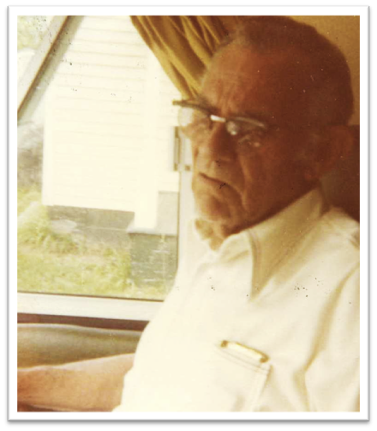
Biography of William Clarence Gauldin

With Historical Context on Mill‑Village Life and Tuberculosis in the Textile South
William Clarence Gauldin entered the world on 16 August 1905 in Leaksville, Rockingham County, North Carolina, at a time when the textile industry dominated nearly every aspect of life in the Piedmont region. He was born into a large family headed by Dock W. Gauldin, a Virginia‑born mill worker, and Annie Catherine Powell, a North Carolinian who devoted her life to raising their children and managing the household economy that sustained them. The Gauldins lived in the mill village that surrounded the factories of Leaksville and Spray, a landscape defined by rows of company‑owned houses, the constant hum of machinery, and the close-knit community of families whose lives revolved around the mills.
By 1910, Clarence was a five‑year‑old boy living in a bustling household of ten children. The census shows him in a home crowded with siblings ranging from nineteen down to an infant, a typical arrangement in mill villages where large families were the norm and every pair of hands eventually contributed to the household’s survival. The Gauldin home, like others in the village, stood close to the mill itself, and Clarence grew up in an environment where the rhythms of daily life were set by the factory whistle. Children played in the narrow alleys between houses, and the mill loomed over everything—economically, socially, and physically. Clarence had not yet begun school and could neither read nor write, but this was common among mill children, whose early years were shaped more by household responsibilities than by formal education.

Sometime between 1916 and 1917, the family suffered a loss when Dock Gauldin died. His death left Annie Catherine a widow with many children still at home, and she responded in the way many widows in mill towns did: she opened her home as a boarding house. Boarding houses were a lifeline for widows, providing income by offering meals and lodging to single mill workers. By 1920, Annie was listed as head of household on Freed Avenue, a street lined with mill houses and boarding homes that formed the heart of the Leaksville mill community.

Clarence, now fifteen, had left school and entered the workforce. He was employed as a doffer in the cotton mill, a job typically assigned to teenage boys. Doffers removed full bobbins from spinning frames and replaced them with empty ones, working in hot, humid rooms where cotton lint floated constantly in the air. His wages helped sustain the household, which still included eight siblings. His adolescence unfolded within the demanding world of mill labor, shaped by responsibility, economic necessity, and the communal life of the mill village.
The mill villages of Leaksville and Spray were self-contained worlds. Families lived in rows of small houses owned by the company, often crowded and poorly ventilated. Entire families worked for the mill, and children frequently entered the workforce in their early teens. Inside the mills, the air was thick with cotton dust—known locally as “fly”—which workers inhaled for long hours each day. The mills were hot, humid, and noisy, and respiratory problems were common. Boarding houses, like the one Annie ran, were crowded and lively places, filled with workers who shared meals, stories, and illnesses. Medical care was limited, and families often relied on home remedies. Tuberculosis, influenza, and pneumonia were constant threats.
It was in this environment that Clarence grew into adulthood. The records between 1920 and 1939 are sparse, but the trajectory of his life mirrors that of many mill workers of his era. Long hours, poor ventilation, and constant exposure to cotton dust created conditions that weakened the lungs and made respiratory disease more likely. Tuberculosis—often called consumption—was rampant in mill villages, spreading easily among workers whose bodies were worn down by hard work and difficult living conditions.
William Clarence Gauldin died of Pulmonary Tuberculosis
Pulmonary tuberculosis, the disease that ultimately claimed Clarence’s life, was one of the leading causes of death in the early twentieth century. It was caused by Mycobacterium tuberculosis, a bacterium spread through airborne droplets when an infected person coughed or spoke. Mill villages provided ideal conditions for its spread. Crowded housing allowed the disease to move quickly from person to person. Poor ventilation in both homes and mills meant that workers breathed recycled air, often filled with dust and germs. Malnutrition, long work hours, and physical exhaustion weakened immune systems, making infection more likely and recovery more difficult. Cotton dust irritated the lungs, creating chronic inflammation that made workers more susceptible to respiratory infections. Although mill work did not cause tuberculosis, it created an environment in which the disease could flourish and in which workers were far more vulnerable to its effects.
By the late 1930s, Clarence’s health had deteriorated severely. He was admitted to Hilltop Sanitarium in Danville, Virginia, a facility known for treating tuberculosis patients from the surrounding region. Sanitariums were often the last resort for those whose illness had progressed beyond what home care could manage. Admission to such a facility usually meant that the disease had reached an advanced stage.

On 29 October 1939, at only thirty-four years old, William Clarence Gauldin died of pulmonary tuberculosis. His death certificate confirmed his parents as D. W. Gauldin and Annie C. Powell, and his passing was registered in Pittsylvania County, Virginia. His early death was tragically common among mill workers of his generation. While mill work did not introduce the tuberculosis bacterium itself, the conditions under which Clarence lived and worked almost certainly accelerated the onset of the disease, worsened its progression, and reduced his ability to recover. The crowded boarding house, the long hours in lint-filled air, the physical strain of mill labor, and the limited access to medical care all contributed to an environment in which tuberculosis could take hold and thrive.

Clarence’s life reflects the broader story of the Piedmont textile South: childhood in a crowded mill village, early entry into industrial labor, the economic pressures of widowhood and boarding-house life, and the ever-present threat of respiratory disease. His story is not only a family history but also a window into the lived experience of thousands of Southern mill families whose lives were shaped by labor, community, hardship, and resilience.
Works Cited
1. 1910 United States Federal Census. ancestry.com. [Online] North Carolina, Rockingham, Leaksville. https://www.ancestry.com/imageviewer/collections/7884/images/4450100_00205?pId=20771450.
2. 1920 United States Federal Census. ancestry.com. [Online] North Carolina, Rockingham, Leaksville. https://www.ancestry.com/imageviewer/collections/6061/images/4383740_00338?pId=32970967.
3. Virginia, U.S., Death Records, 1912-2014. ancestry.com. [Online] 1939. https://www.ancestry.com/imageviewer/collections/9278/images/43004_172028008151_0142-00350?pId=716551.
4. Divalls of Danville. oldwestendva.com. [Online] https://oldwestendva.com/blog/the-dibrells-of-danville/.
© 2026 Catherine L. Gauldin, Gaulding Origins. All original content protected. Use of this site implies agreement with the Terms of Use and Privacy Policy.


Comments