The Family of Thomas J. Gauldin and Mahala Woodall

Updated: Aug 17
Thomas J. Gauldin and Mahala Woodall were born into two branches of the same sprawling Pittsylvania County kin network—families whose roots reached back to the Revolutionary War and whose descendants shaped the Callands, Whitmell, and Tunstall communities for generations. Their lives, intertwined from birth through marriage, family, migration, and death, form one of the central threads in the Gauldin–Woodall story.
Origins in Two Interconnected Families
Thomas was born on April 1, 1817, in Pittsylvania County, the son of Thomas D. Gauldin (1784–1871) and Margaret “Peggy” Walker (1788–1860). Mahala was born three years later, on March 12, 1820, in Vandola, Pittsylvania County, to John W. Woodall (1797–1831) and Elizabeth Gaulding, daughter of William Turner Gaulding and Margaret “Peggy” Lane. This meant that Thomas and Mahala were first cousins, both grandchildren of Revolutionary War soldier William T. Gauldin. Their families lived close to one another, intermarried frequently, and formed a dense kinship network that shaped every aspect of their lives. Mahala’s father died when she was only eleven, leaving her mother to raise four children—William F., Samuel Jefferson “Sam,” Mahala, and Samantha—within the support system of the Gauldin and Woodall families.

Marriage and Early Household
On September 13, 1838, eighteen‑year‑old Mahala married twenty‑one‑year‑old Thomas in Pittsylvania County. Her mother, Elizabeth Woodall, gave consent, and the ceremony was performed by Rev. Nathan Anderson. (2) The marriage united two branches of the Gauldin family and reinforced the kinship ties that defined rural Pittsylvania society. The young couple settled in the Southern District of Pittsylvania County, where Thomas worked as a farmer. By 1850, they had already built a large household: James age 11, Almira 9, John age 7, William 5, Eliza 3 and Robert age 1.
Mahala, listed as unable to read or write, managed the household—a role that required constant labor, from cooking and sewing to tending gardens and caring for children.

A Family That Kept Growing
The 1860 census shows Thomas and Mahala living in Whitmell with an even larger family. Their children now included:
James H.
Almira
John
William
Eliza A.
Robert
Harden
Thomas Jr.
Harriett
Parthenia
Mary
A newborn infant – This is their last child, Dock

Thomas’s agricultural holdings were modest but stable, and he lived near Woodall and Dodd relatives, reflecting the tight clustering of kin in the area.
By 1870, the family had moved north of the Dan River near Chatham. Their household still included many children—Eliza Ann, Thomas Jr., Harriett, Parthenie, Mary, Mahallie, Elizabeth L., Doctor, Samuel, and John—showing that even as their older children married or moved out, the younger ones continued to fill the home.

In 1880, Thomas and Mahala were living in Tunstall, Pittsylvania County, both listed as age 68. Their household still included Eliza A. age 32, Parthenia age 24, Mary age 22, Virginia age 19, Laura 17, Doc age 13, Sam age 12 and Fletcher 7.

Mahala’s occupation was listed simply as “Keeping House,” a phrase that belies the enormous labor required to maintain such a household.
Thomas and Mahala ultimately had fifteen children, including:
James Henry (1839–1900)
Almira Virginia “Mollie” (1839–1920)
John D. (1842–1935)
Eliza Ann “Nannie” (1843–1880)
William J. “Bill” (1847–1934)
William Thomas “Tom” (1850–1917)
Harriett E. (1852–1874)
Hardin Nash (1855–1930)
Mary (1858–1880)
Mahala “Mahallie” (1860–1880)
Parthenia Ella (1862–1912)
Elizabeth Laura (1863–1880)
Samuel “Sam” Bethel (1865–1951)
Dock Whitfield (1866–1919)
Robert Morton (1850–1930)
Fletcher was their grandson.


The lives of the children of Thomas J. and Mahala Gauldin spanned the Civil War, Reconstruction, industrialization, and the early twentieth century. Some died young; others lived long lives. Their son Dock died in the 1919 flu epidemic, and William Gaulding died in 1934 at the County Home. Robert Morton lived to age 80.

Migration to North Carolina
Late in life, Thomas and Mahala followed a pattern common among Pittsylvania families: they moved to Rockingham County, North Carolina, seeking work in the fabric mills. This migration marked a shift from agricultural labor to industrial employment and reflected broader economic changes in the post‑Reconstruction South. See Gaulding Origins, The Fabric Mills on the Dan River for a complete description of how important the work provided by the Fabric Mills was to families like the Gauldin family.
Death and Estate
Mahala died in August 1891 at Bachelor’s Hall, Pittsylvania County. No formal death record has been found, but her passing is documented in family records. Thomas died the following year, in 1892, in Rockingham County. His estate was probated in 1893, leaving behind a folder of papers that testify to settling of his affairs.
Narrative Summary: The Estate of Thomas J. Gauldin (1893)
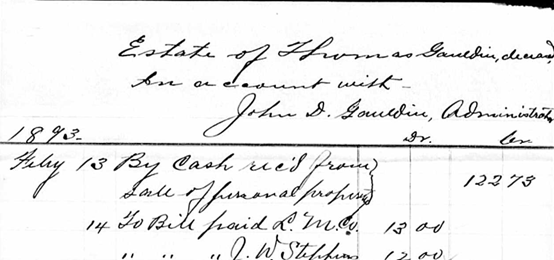
When Thomas J. Gauldin died in 1893 in Rockingham County, North Carolina, he left behind not only a large family but also a modest collection of personal property accumulated over a lifetime of farming. His death set in motion the formal probate process, overseen by his son John D. Gauldin, who served as administrator of the estate. The records preserved from this process offer a rare and intimate glimpse into Thomas’s daily life, his possessions, and the way his children navigated the responsibilities of settling their father’s affairs.
Inventory of Thomas’s Property
On January 21, 1893, three men—John D. Gauldin, D.M. Moore, and T. Terry—assembled to take a full inventory of Thomas’s belongings. Their list reads like a snapshot of a nineteenth‑century farmer’s world. In John’s possession were:
A sorrel mare named Fan
A red and white cow named Cammie
A white and black heifer named Cherry
A white and red steer yearling named Brick
About sixty pounds of pork
A pistol, five old guns, and assorted farm tools
Two skillets, an oven, a bread tray, sifter, stone churn, and buckets
A feather bed, bedstead, chests, desk, table, and chairs
A carry‑all, harness, half‑bushel measure, and other household necessities

These items paint a picture of a man who lived simply but self‑sufficiently, relying on livestock, basic tools, and well‑used household goods. It is obvious from the inventory that he did not own the land he was living on.
Other property not yet in John’s possession included:
12–15 barrels of corn
12–15 barrels of shucks
A small lot of fodder
A double‑shovel plow, frower, saddle, hoes, and a grubbing hoe
The inventory was sworn before Jno. T. Parnall, Clerk of Superior Court, on January 23, 1893, marking the official start of probate.
Petition to Sell the Estate
As administrator, John faced a practical problem: selling property on credit often discouraged bidders, and requiring bonds made buyers reluctant. To avoid complications, he petitioned the Superior Court for permission to sell the estate for cash only.
His petition stated plainly:
Selling on credit was inconvenient
Requiring bonds would reduce bidding
The estate’s best interest required a cash sale
The court agreed. On January 23, 1893, Clerk Jno. T. Parnell issued an order authorizing John to sell the property for cash after proper advertisement.

Sale and Distribution
The sale of Thomas’s personal property brought in $122.73, a modest sum reflecting the simple nature of his belongings. From this amount, the administrator paid:
Court fees
Doctor’s fees
Payments to merchants
Compensation for individuals who assisted with the inventory
A small commission to himself (5% of the total)
After expenses, the remaining funds were divided among Thomas’s heirs. Each received $4.30, a symbolic inheritance rather than a substantial one. The beneficiaries included:
J.D. Gauldin
Sam Gauldin
Laura Gauldin
Robert M. Gauldin
James H. Gauldin
Almira Pruitt
D.W. Gauldin
Alma Pruitt
W.J. Gauldin
Janie Gauldin
Molly Gauldin
Wash Gauldin
Thomas Gauldin
The equal distribution reflects the legal requirement to divide an intestate estate among surviving children or their representatives.
A Glimpse Into a Life
The probate records of Thomas J. Gauldin reveal a man whose life was rooted in farming, family, and the practical realities of rural nineteenth‑century living. His possessions were not grand, but they were the tools and comforts of a working man: livestock, guns, farm implements, cooking vessels, and simple furniture.
The careful listing of each item—down to the bread tray, coffee mill, and two chairs—captures the material world of a man who lived through the antebellum era, the Civil War, Reconstruction, and the rise of industrialization. The small inheritance left to each child underscores the economic challenges faced by many families of the era, especially those who migrated from Virginia to North Carolina seeking work in the textile mills.
A Shared Legacy
Together, Thomas and Mahala represent the heart of the nineteenth‑century Gauldin family story. Their marriage united two branches of a Revolutionary War lineage. Their household—large, multigenerational, and constantly evolving—reflected the rhythms of rural life in Pittsylvania County. Their children carried the Gauldin name into both Virginia and North Carolina, shaping communities on both sides of the state line.
Works Cited
1. 1830 United States Federal Census. ancestry.com. [Online] Pittsylvania County, Virginia. https://www.ancestry.com/imageviewer/collections/8058/images/4411349_00809?pId=957125.
2. Pittsylvania County Va. marriage records. ancestry.com. [Online] Virginia, Marriages, 1740-1850, "Sept. 13 1838 Thomas Gauldin to Mahala Woodall, Sur. Christopher Bray, Elizabeth Woodall, mother. Married by Rev. Nathan Anderson".
3. 1850 United States Federal Census. ancestry.com. [Online] Pittsylvania, Virginia, Southern District. https://www.ancestry.com/imageviewer/collections/8054/images/4206390_00165?pId=15427331.
4. 1860 United States Federal Census. ancestry.com. [Online] Pittsylvania County, Virginia, Southern District. https://www.ancestry.com/imageviewer/collections/7667/images/4298865_00397?pId=34102376.
5. 1870 United States Federal Census. ancestry.com. [Online] Pittsylvania County, Virginia, Subdivision North of the Dan River. https://www.ancestry.com/imageviewer/collections/7163/images/4268802_00308?pId=39297073.
6. 1880 United States Federal Census. ancestry.com. [Online] https://www.ancestry.com/imageviewer/collections/6742/images/4244750-00406?pId=19081304.
7. North Carolina, U.S., Wills and Probate Records, 1665-1998. ancestry.com. [Online] Rockingham, Wills, 1663-1978; Estate Papers, 1780-1926. https://www.ancestry.com/imageviewer/collections/9061/images/007384275_01918?pId=1678508.
© 2026 Catherine L. Gauldin, Gaulding Origins. All original content protected. Use of this site implies agreement with the Terms of Use and Privacy Policy.


Comments