Moses Gaulding, the son of William T. Gaulding and Margaret Lane
- Catherine Gauldin
- Jul 7
- 15 min read

Moses Gauldin, son of William T. Gaulding and Margaret Lane, was born around 1790, likely in Bedford County, Virginia, and died sometime after 1850 in Pittsylvania County. There is no birth or death record. He married Susannah “Susan” Elliott on October 15, 1810, in Henry County, Virginia. Susan, born about 1790, was almost certainly a native of Henry County. Her sister Nancy Elliott married Moses’s brother, creating a double family connection between the Gauldings and the Elliotts. (1) See the Outline Descendant Report for William T. Gaulding on Gaulding Origins for a complete list of the Descendants of Moses Gaulding.
Moses Gauldin’s Household in the 1820–1840 Censuses
The census records for Moses Gauldin provide a valuable glimpse into the structure of his household as it grew during the early nineteenth century. Although the censuses list only age ranges rather than names, the surviving birth years of Moses and Susannah’s children allow us to match each child to the most likely census entry.
In 1820, Moses appears in Pittsylvania County as a white male under 45, living with a white female under 45—almost certainly his wife Susannah “Susan” Elliott—and one white female under 10. At this date, Moses and Susan had only one child old enough to appear in the census: Alice/Alsie/Alcey Gauldin, born about 1813. She fits the “female under 10” category precisely. James Elliott, Thomas Gaulden, William Gaulden and Moses Gaulden are all living in close proximity to each other, probably on the property William T. Gaulding accumulated during his lifetime.

By 1830, Moses is recorded as a white male aged 40–50, with a white female aged 50–60, again consistent with Susan’s approximate birth year of 1790. The household now includes five children:
One white male age 5–10 → This matches Samuel Gauldin, born 1817. It isn’t known why Samuel was not listed in the 1820 census.
One white female age 5–10 → This fits Nancy Gaulding, born 1815.
One white female age 10–15 → This corresponds to Jane Gaulding, born 1816.
Two white females age 10–20 → These two older girls are most likely Alice/Alsie (b. 1813) and Margaret “Peggy” Gaulding (b. 1813), who were close in age and would both fall within the 10–20 bracket.
This reconstruction aligns perfectly with the Moses and Susan’s children and explains the total of seven individuals in the household.
In 1830 Moses’ father William Gaulding was still living in the same cluster of neighbors that he was living in in 1820, but both Thomas and Moses appear to have moved to another part of Pittsylvania County in 1830. In 1840 William T. Gaulding and his sons were again living in close proximity to each other.
William T. Gaulding in 1830: (3) Samuel Uhles Mary Bray C. Sholmate Jonathan Elliott William Tarpley Joel Matherly James Elliott John Woodall Andy Gauldin David W. Breedlove William Gauldin N.H. Taliafina John McCune James Beck Richard Breedlove John Fowlkes Moses Herndon and others.. | Moses and Thomas Gaulding in 1830: (3) Armisted Stratten Moses Galden Benjamin King Thomas Galden C Robertson, Jr. Thomas Boze Micajah Dodson William Newton Burwell Law, jr. Philip Elliott John Elliott William Herndon and others | Moses Gaulding in 1840: (4) James R. Allen Francis Pace Nicholas Pace Herndon Thomas Catherine Dunn William T. Galding Stephen Midkiff David W. Breedlove Andy Galding Thomas Galding, Sr. Moses Galding John Boaz Lindsey Breedlove Luke P. Tarpley Jonathan Elliott Thomas Boaz John Foulks Henry Burnet and others | Moses Gaulding in 1850 |
No confirmed birth record has been found for Susannah Elliott, and her exact parentage remains unproven. The proposed connection to James Elliott and his wife Mary arises because it is the only scenario that aligns with the limited evidence available. Several secondary sources report that Susannah, who married Moses Gaulding, was born in Maryland, and James Elliott is documented as having come from Baltimore before settling in Pittsylvania County, Virginia. (5) Her birthplace is given as Maryland on the 1850 census. The families were closely associated: James and Mary Elliott’s son, William James Elliott, married Nancy Gaulding, Moses’s sister. This creates a plausible network linking the Elliotts and Gauldings, suggesting that Susannah may have belonged to the same Elliott family. No surviving document directly identifies Susannah as James and Mary’s daughter, and the relationship—while reasonable—remains unverified. (1)
A man named Moses Gauldin also appears in Pittsylvania County in the 1840 census (4). This census shows two children, both under the age of 5.
Moses Golding | Residence Date 1840 |
Home in 1840 (City, County, State) Pittsylvania, Virginia | Free White Persons - Males - Under 5 1 |
Free White Persons - Males - 40 thru 49 1 | Free White Persons - Females - Under 5 1 |
Free White Persons - Females - 20 thru 29 1 | Free White Persons - Females - 40 thru 49 1 |
Persons Employed in Agriculture 1 | No. White Persons over 20 Who Cannot Read and Write 3 |
Free White Persons - Under 20 2 | Free White Persons - 20 thru 49 3 |
Total Free White Persons 5 | Total All Persons - Free White, Free Colored, Slaves 5 |
Is this the boy named Thomas that Ronnie Wood includes in his genealogy? If there was such a person, he cannot be the same Thomas Gaulding who married Mahala Woodall. Of course these children could easily be the children of the daughter who is shown in this same census age 20-29. Without birth records, it is difficult to come to a concise conclusion. The more plausible explanation is that the two young children, a boy and a girl under 5 years are grandchildren rather than children, because Susannah, if she were still alive would be fifty years old in 1840, therefore it is my conclusion that the Thomas included below was a grandson rather than a son and that he and his sister, both the children of one of the daughters or sons of Moses and Susannah was living with their grandparents.

Together, the census records and the children’s birth years create a coherent picture of Moses and Susannah’s household as it developed between 1820 and 1830, allowing us to identify each child within the census categories and to better understand the family’s structure during these decades.
Moses Gaulding was convicted of petit larceny
According to the 1830 Pittsylvania County court records, Moses Gauldin was committed to the county jail on a charge of petit larceny. To secure his release, his father William T. Gaulding and his brother Thomas Gauldin each posted a $25 recognizance bond, guaranteeing Moses’s appearance in court and his good behavior. Legally, this meant Moses was formally accused of a misdemeanor theft and placed under court supervision. If he failed to appear for trial or violated the conditions of release, the Commonwealth could collect the bond from William and Thomas, and Moses could be jailed again or face additional penalties. A petit larceny charge also carried social consequences: it placed Moses under public scrutiny, created a recorded mark against his reputation, and could affect his standing in the community, even if the case was later dismissed or resolved without further punishment.
In October 1841, just months after the death of his father, Moses Gauldin entered into a formal bill of sale with Thomas S. Jones, recorded in Pittsylvania County Deed Book 45. For a payment of $600, Moses transferred all of his rights as a legatee in the estate of William T. Gauldin, deceased. In effect, Moses sold his entire inheritance—his share of land, enslaved people, personal property, and any future proceeds from the estate—to Jones. Once this indenture was executed and recorded, Moses no longer possessed any legal claim to his father’s estate. Jones stepped fully into Moses’s place and became the person entitled to receive whatever Moses would have inherited.
Legally, the repercussions were significant. By conveying his “shares as a legatee,” Moses permanently surrendered his standing in all estate matters. He forfeited the right to participate in the division of property, to receive payments from commissioners, or to challenge or approve any settlement. The court was required to recognize Jones as the new owner of Moses’s portion, and all future distributions or legal actions involving that share were directed to Jones rather than Moses. For the other Gauldin heirs, this meant that Jones—and later his daughter—became a co‑claimant in the estate, with the same authority Moses would have held. The transaction also suggests that Moses may have needed immediate cash, as $600 was a substantial sum in 1841. Whatever his reasons, the deed marks a decisive moment: Moses removed himself from his father’s estate entirely, and Thomas S. Jones became the legal heir in his stead.
The 1842 Trust and Sale Involving Moses Gauldin
In June of 1842, Moses Gauldin entered a period of financial strain that is documented through two closely connected Pittsylvania County deeds. On June 4, 1842, Moses executed a trust deed in which he acknowledged that he was indebted to Dr. A. Herndon in the amount of $81.50. To secure this debt, Moses conveyed his 70‑acre tract on Strawberry Creek—the land where he was living—to Benjamin F. Williams, acting as trustee. This arrangement meant that if Moses failed to repay Dr. Herndon, Williams was legally empowered to sell the land at public auction, after giving thirty days’ notice, and use the proceeds to satisfy the debt. Any remaining balance would be returned to Moses. Trust deeds like this were common in Virginia and functioned as a form of collateral: Moses kept possession of the land, but its title was legally tied to repayment of the debt.
Just weeks later, a second deed reveals what happened next. On May 7, 1842 (recorded June 20), Joshua Pritchett, acting under an earlier 1839 trust arrangement involving a man named Haymore, advertised and sold the same 70‑acre tract at public auction. At that sale, Moses himself was the highest bidder, purchasing the land for $150.87. In other words, Moses bought back the very property that had been placed in trust—likely because the land had been foreclosed or sold under the terms of the earlier Haymore deed. The price Moses paid was significantly higher than the amount he owed Dr. Herndon, suggesting that multiple debts or liens were attached to the property.
Taken together, these documents show that Moses was struggling to manage overlapping financial obligations. He first placed his land in trust to secure a medical debt, and shortly afterward, the same land was sold under a separate trust arrangement. Moses managed to repurchase the property, but only by paying a substantial sum at auction. These transactions illustrate both the precariousness of his financial situation and the complicated web of debt, trust deeds, and land security that shaped the lives of many small farmers in antebellum Pittsylvania County.
In 1844, Moses Gauldin appeared as a co‑plaintiff in the chancery case Andy Gauldin et al. vs. Elizabeth Woodall, a suit involving the heirs of William T. Gaulding. His wife at the time was Susannah “Susan” Elliott, whom he had married in Henry County on October 16, 1810.
Moses Gaulding and Susannah his wife appear for the last time in the 1850 Census of Pittsylvania County. It is surprising to learn in this census that Susan was ten years older than Moses. The census states that she was born in Maryland.

Commonwealth vs John B. Oakes & Moses Gauldin
In the spring of 1853, Moses Gauldin appeared once more in the Pittsylvania County court records, this time alongside John B. Oakes in a case styled Commonwealth vs. John B. Oakes & Moses Gauldin. The first entry, dated 23 March 1853, simply notes that the case was brought before the county court, but—like many minor criminal matters of the period—no surviving documents describe the nature of the charge, the circumstances that led to the prosecution, or the evidence presented. Months later, on 22 November 1853, the court recorded its final action: John B. Oakes was found “not guilty,” and the clerk added that “the other defendant has departed this life.” With that brief phrase, the court formally acknowledged that Moses had died sometime between the opening of the case in March and its resolution in November.
No additional papers, indictments, witness lists, or docket notes survive, and the order book entries are the only remaining trace of the proceeding. Yet even this small fragment of information is significant. It provides one of the last documented moments of Moses’s life, confirms that he was still living in Pittsylvania County in early 1853, and establishes a narrow window for his death later that same year. This case gives us one of the last documented moments of Moses’s life. It shows:
He was still living in Pittsylvania County in early 1853.
He was involved in a minor criminal matter with John B. Oakes.
He died before the case could be heard.
The court formally acknowledged his death in November 1853.
Although the nature of the charge is unknown, the record provides a valuable chronological anchor for his death and one final glimpse into his life.
The census records help confirm the identity of Moses and Susan’s children.
1. Alice Alsie Alcey Gauldin 1813-After 1860 - She was born about 1813 in Pittsylvania County, Virginia and died after 1860, probably in Pittsylvania County. That is the last census (8) she appears in. That census records the following information: Alcey Bray, 47, born about 1813 in Virginia was living in the Southern District of Pittsylvania County, Virginia. She was married to Christopher Bray (9) age 66 and their children were Susan, Elisha 13, Matilda 11 and Labinda age 8. Her husband, Christopher Bray, was a shoemaker. A comparison of the 1850 and 1860 Census shows a peculiar mixture of people, with James Elliot, who was the husband of Nancy Gaulding living in his household. Alcey is absent from the 1850 Census. Christopher Bray was the son of Ambrose II Bray (1760-1860) and Mary Crouch (1769-1830). His sister was Unity Bray (1800-unknown) who married Andrew Jackson "Andy" Gauldin, the son of William T. Gaulding and Margaret Lane. (9)
1850 Census Christopher Bray 60 Robert Golden 16 Susan Golden 7 Elisha Golden 5 Matilda Golden 1 James Eliot 80 | 1860 Census Christopher Bray 66 Alcey Bray 47 Susan Bray Elisha Bray 13 Matilda Bray 11 Labinda Bray 8 |
2. Margaret "Peggy" Gaulding 1813–1898 - Margaret “Peggy” Gaulding, born about 1813, who married William Haymore on April 8, 1834, with Moses Gaulding serving as surety. (1) She is seen in the 1850, 1860 and 1880 census but not in 1900.
1850 Census Peggy Hamore, born about 1813 in Virginia, living in the Northern District, Pittsylvania County, VA. Married to William Haymore. Household members William Hamore 37 Peggy Hamore 37 Polly Hamore 13 Susan Hamore 10 Martha Hamore 9 Reuben Hamore 7 Thomas Hamore 6 James Hamore 5 Hardin Hamore 3 William Hamore 1 William Madding 65 | 1860 Census (11), Margaret Haymore age 45, living in the Southern District, Pittsylvania County, Va. Married to William Haymore. Household: William Haymore 49 Margaret Haymore 45, Susan E Haymore 20, Martha L Haymore 18, Reuben Haymore, James Haymore 13, Harden Haymore 12, William Haymore 11, Presley Haymore 9, Doctor Haymore 5 Rebecca J Haymore 4
Daughter Rebecca is listed in the Virginia, U.S., Birth Registers, 1853-1911 (12) | 1880 Census (12), Margaretta Haymore, age 60 living in her son Dock Haymore's household in Callands, Pittsylvania County, Virginia. Household Dock Haymore 25, Matilda Haymore 26, Lucy Haymore 5, Samuel Haymore 2, William Haymore 70 and Margaret Haymore 60.
Dock Haymore was born 6 August 1853 in Pittsylvania County, Virginia and he died in 1912. He married Catherine Matilda Burnett (1852-1936), the daughter of Barksdale "Buz" Burnett (1819-1870) and Elizabeth Delia "Betty" Gaulding. | 1900 Census (13) Margaret was dead by 1900 but her husband William lived past the age of 96. He is seen for the last time living with his daughter Martha Haymore age 61 in Chatham, Pittsylvania County, Virginia. He was the head of the household and they were living near John Haymore (wife Lelia and son Bill) and (?) Haymore with wife Matilda and children Lucy, Samuel, Loyd, Mary, Lillie, William, Matie, Nannie and Ruth. |
3. Nancy Gaulding 1815–1891 - Her death record incorrectly gives the names of her parents as “Moses and Jane Gaulden”. She married John B. Eanes who served the Confederacy during the Civil War. According to the U.S., Civil War Soldier Records and Profiles, 1861-1865 John Eames enlisted in the Confederate Army at the age of 52 on 10 July 1861 at Henry County. He was in Company F of the 57th Infantry. He mustered out on 20 November 1861 after having served just a few months. He was a Mechanic.

4. Jane Gaulding 1816–1870 - Jane Gaulding, born between 1810–1820, who married James Powell on September 27, 1842, with William Haymore as surety. (1) Jane Gaulding was born around 1816 in Pittsylvania County, Virginia, one of the daughters of Moses Gauldin and Susannah “Susan” Elliott. On 27 September 1842, at about age twenty‑six, Jane married James Powell in Pittsylvania County. (16) Their marriage bond confirms the union, and by 1850 the couple was living in the Southern District of Pittsylvania County, where James worked as a farmer and Jane managed their growing household. The 1860 census (17) places the Powells in the Whitmell area of Pittsylvania County. Jane, then forty‑four, appears with her husband and five children: Susan (15), Nannie (13), Henson F. (7), Rebecca A. (6), and Elisha M. (4). These records show a typical mid‑century rural Virginia family—modest, working the land, and raising children in a community of small farms. By 1870, Jane’s circumstances had changed dramatically. She and James were living in Chatham, Pittsylvania County, and both were recorded as “paupers.” This designation indicates that they were receiving county assistance or living on public support, a fate not uncommon for aging couples who had lost property, income, or the ability to work. Jane was listed as 56 years old, and this is the last confirmed record of her life.
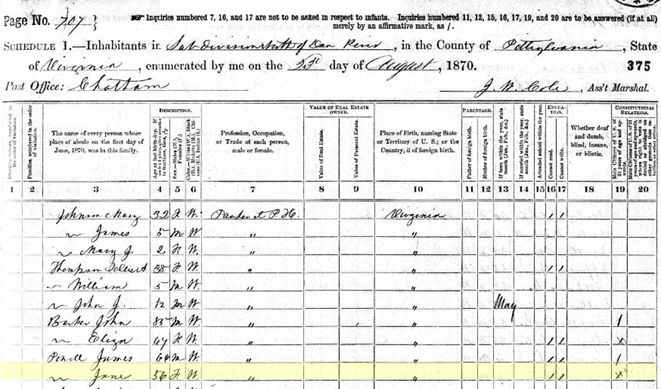
Jane Gaulding Powell likely died sometime after 1870 in Pittsylvania County. Although no death record has been found, the census entries preserve the essential outline of her life—from her birth in the Gauldin household, through marriage and motherhood, to her final years marked by hardship.
1. Samuel Gauldin 1817–1862 - Researcher R. Wood also placed Samuel Gauldin, born 1816, as a son of Moses. Samuel married Catharine Johnson, again with William Haymore acting as surety. Samuel Gaulding was born on 13 May 1817 in Pittsylvania County, Virginia, one of the younger children of Moses Gauldin and Susannah “Susan” Elliott. He grew up along Strawberry Creek in a farming household typical of rural Pittsylvania County in the early nineteenth century. At just 19 years old, Samuel married Catherine “Caty” Johnson on 20 December 1836 in Pittsylvania County. (19) Their marriage bond lists Catherine’s father, John Johnson, as signer, and William Haymore—a frequent associate of the Gaulding family—as surety. Samuel and Catherine began their married life in Pittsylvania County, where Samuel worked as a laborer and farmer. By 1850 (20), Samuel appears in the Southern District of Pittsylvania County with Catherine and their growing family: Lucretia, Eliza, Cooney, Ellender, John L., Elizabeth, and William. The 1850 slave schedule (21) also records Samuel as the owner of four enslaved people, reflecting the economic structure of small-scale slaveholding farmers in the region. The 1860 census (22) shows the family living in Swansonsville, Pittsylvania County, with an expanded household that now included James, George W., Robert M., and Wyatt. Samuel’s life, like many in his generation, was soon overtaken by the Civil War. On 1 March 1862, Samuel enlisted as a Private in Company I, 57th Virginia Infantry, part of the Confederate Army. His service was brief. While stationed near Richmond, Samuel contracted measles, a common and often deadly illness in crowded military camps. He died on 13 May 1862, his 45th birthday, and was buried in Richmond. His death occurred just months after enlistment, and he did not survive to see the later years of the war. More than two decades later, in 1888–1889, his widow Catherine Johnson Gauldin filed for a Virginia Confederate Widow’s Pension (23), confirming Samuel’s service and his death from measles while in uniform. Her application, filed from Dyer’s Store in Henry County, preserved the final official record of Samuel’s life. Samuel Gaulding’s story reflects the experiences of many rural Virginia men of his era—early marriage, a large farming family, modest slaveholding, and a wartime death from disease rather than battle. For more detailed information, see Gaulding Origins The Life and Death of Samuel B. Gaulding.
Together, these records show Moses as an active participant in family legal matters, a father of several children whose identities can be partially reconstructed through census categories and marriage bonds, and a man whose household structure aligns closely with the surviving documentary evidence from Pittsylvania County.
Taken together, the surviving records paint only a partial picture of Moses Gauldin’s life—one shaped by family ties, shifting property holdings, and moments of financial strain. His appearance in the 1844 chancery suit shows him participating fully in the legal affairs of the Gaulding heirs, while the marriage bonds and census entries allow us to identify most of his children and trace the growth of his household across three decades, yet other parts of his story remain obscured. The 1830 court record noting his confinement on a charge of petit larceny offers no explanation of the circumstances, the evidence, or the outcome, leaving us with only the bare fact of the accusation and the bond posted by his father and brother. Like many individuals of his era, Moses moves in and out of the documentary record, visible only where legal, financial, or family events required his name to be written down. What we can say with certainty is that these scattered entries—census lines, marriage bonds, trust deeds, and court cases—preserve the essential outlines of his life and ensure that he is not lost to time, even when the fuller story remains beyond our reach.
Works Cited
1. Gauldin, Catherine L. The Gaulding Family of Pittsylvania County, Virginia.
2. 1820 United States Federal Census. ancestry.com. [Online] Pittsylvania, Virginia. https://www.ancestry.com/imageviewer/collections/7734/images/4433241_00106?pId=1121040.
3. 1830 United States Federal Census. ancestry.com. [Online] Pittsylvania, Virginia. https://www.ancestry.com/imageviewer/collections/8058/images/4411349_00811?queryId=a84950b9-3c99-44f3-b80c-b1f577e1d655&usePUB=true&_phsrc=osm5267&_phstart=successSource&usePUBJs=true&pId=957123.
4. 1840 United States Federal Census. ancestry.com. [Online] Pittsylvania, Virginia. https://www.ancestry.com/imageviewer/collections/8057/images/4410827_00246?pId=1913686.
5. Source is unknown.
6. Wood, Ronnie. Moses Gaulding, 1790. ancestry.com. [Online] https://www.ancestry.com/mediaui-viewer/collection/1030/tree/163174124/person/422121231081/media/4de432af-2540-4492-b591-e1a647804c9e?galleryindex=1&sort=-created.
7. 1850 United States Federal Census. ancestry.com. [Online] https://www.ancestry.com/imageviewer/collections/8054/images/4206390_00500?pId=15441362.
8. 1860 United States Federal Census. ancestry.com. [Online] Southern District, Pittsylvania County. https://www.ancestry.com/imageviewer/collections/7667/images/4298865_00425?pId=33812807.
9. Virginia, U.S., Select Marriages, 1785-1940 . ancestry.com. [Online] https://www.ancestry.com/search/collections/60214/records/1495903?tid=163174124&pid=422515528169&ssrc=pt.
10. Christopher Bray. Find a Grave. [Online] https://www.findagrave.com/memorial/84452357/christopher-bray.
11. 1860 United States Federal Census. ancestry.com. [Online] William Haymore. https://www.ancestry.com/imageviewer/collections/7667/images/4298865_00403?pId=34374857.
12. Virginia, U.S., Birth Registers, 1853-1911. ancestry.com. [Online] https://www.ancestry.com/imageviewer/collections/62153/images/62153_i1023879-00211?pId=30798837.
13. 1880 United States Federal Census. ancestry.com. [Online] Margaret Haymore, Virginia, Pittsylvania, Callands. https://www.ancestry.com/imageviewer/collections/6742/images/4244682-00670?pId=42858871.
14. 1900 United States Federal Census. ancestry.com. [Online] William Haymore. https://www.ancestry.com/imageviewer/collections/7602/images/4117884_00660?pId=72177435.
15. Virginia, U.S., Death Registers, 1853-1911. ancestry.com. [Online] https://www.ancestry.com/imageviewer/collections/62152/images/62152_i870362-00304?usePUB=true&usePUBJs=true&pId=470233.
16. Virginia, U.S., Compiled Marriages, 1740-1850 . ancestry.com. [Online] https://www.ancestry.com/search/collections/3723/records/1065849?tid=163174124&pid=422121228413&ssrc=pt.
17. 1860 United States Federal Census. ancestry.com. [Online] Jane Powell. https://www.ancestry.com/search/collections/7667/records/34101801.
18. 1870 United States Federal Census. ancestry.com. [Online] https://www.ancestry.com/imageviewer/collections/7163/images/4268802_00756?usePUB=true&usePUBJs=true&pId=39302013.
19. Virginia, U.S., Compiled Marriages, 1740-1850. ancestry.com. [Online] https://www.ancestry.com/search/collections/3723/records/129842?tid=163174124&pid=422121229818&ssrc=pt.
20. 1850 United States Federal Census . ancestry.com. [Online] Samuel Gaulding. https://www.ancestry.com/search/collections/8054/records/15427053.
21. 1850 U.S. Federal Census - Slave Schedules . ancestry.com. [Online] https://www.ancestry.com/search/collections/8055/records/92939506.
22. 1860 United States Federal Census . ancestry.com. [Online] Samuel Gaulding. https://www.ancestry.com/search/collections/7667/records/34650104.
23. Alabama, Texas and Virginia, U.S., Confederate Pensions, 1884-1958. ancestry.com. [Online] Widow's Pension application Catherine. https://www.ancestry.com/imageviewer/collections/1677/images/31867_B034251-00207?pId=1050519.
© 2026 Catherine L. Gauldin, Gaulding Origins. All original content protected. Use of this site implies agreement with the Terms of Use and Privacy Policy.


Comments