James Henry Gauldin & Elizabeth Frances “Fanney” Woodall

A Dan River Family in the Virginia–North Carolina Piedmont, 1839–1915
In the quiet agricultural landscape of Pittsylvania County, Virginia, where the Dan River winds through small farms and kin networks that had endured for generations, James Henry Gauldin was born on 21 July 1839. He entered a world defined by family labor, modest means, and the stability of multigenerational households. His parents, Thomas J. Gauldin and Mahala Woodall, were typical of rural Virginia farmers of the mid‑nineteenth century—working small tracts of land, raising large families, and living close to extended kin.
The 1850 census captures James at age eleven in the Southern District of Pittsylvania County, surrounded by six younger siblings. His father’s farm, valued at $250, stood adjacent to the property of James’s grandfather, Thomas Gauldin, Sr., whose own land was worth $100. The proximity of these households reflects the deeply rooted Gauldin presence along the Dan River, where family members lived, worked, and worshipped within walking distance of one another.
By 1860 (1), James was twenty and working as a factory hand in the Whitmell area of Pittsylvania County. The census notes that he could not read or write—a common circumstance among rural laborers whose education was often secondary to farm and factory work. He still lived at home with his parents and numerous siblings, in a household that embodied both the industriousness and the economic limitations of small Virginia farmers on the eve of the Civil War.
Just a few miles away, Elizabeth Frances “Fanney” Woodall was growing up in Whitmell. Born on 27 August 1840, she was the daughter of William F. Woodall and Ellender “Nellie” Price. Fanney’s childhood was shaped by the early death of her father, leaving her mother to manage a household of children in a region where widows often relied on extended kin and the labor of older daughters. The 1850 and 1860 censuses show Fanney living with her widowed mother and younger brothers, contributing to domestic work and helping sustain the family through difficult years.
On 24 June 1867, James and Fanney married in Pittsylvania County, joining two families whose histories were intertwined through land, labor, and community ties. Their marriage marked the beginning of a large family whose children bore names reflecting both tradition and the era’s fondness for state‑inspired naming: Emma “Octavia,” Louisiana, Delaware, Edward Lee, Indiana Georgia (“Indy”), Missouri, and Betty Kate. These names hint at a sense of creativity and Southern identity within the Gauldin household.
The move to North Carolina to work in the mills
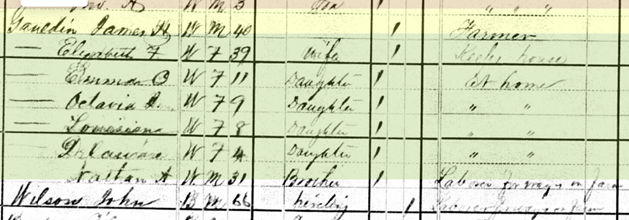
By 1870, James and Fanney were living in Leatherwood Township, Henry County, Virginia, near Martinsville, with their first child, Emma. The young family soon expanded, and within a decade they moved south across the state line to Leaksville, Rockingham County, North Carolina, where James worked as a farmer. The 1880 census (2) shows a bustling household: Emma, Louisiana, and Delaware were growing into their roles as helpers within the home, while younger siblings filled the house with activity. James’s brother Nathan lived with them, reflecting the extended family networks common in the Piedmont.
Life in Leaksville placed the Gauldins near the emerging textile mills that would later define the region’s economy. Although James remained a farmer, the family’s proximity to industrial development foreshadowed the future paths of their children and grandchildren, many of whom would later live and work in mill towns along the Dan River.
The Gauldins also endured hardship. Two of their daughters—Emma Octavia and Louisiana—died young, likely around 1880. Their absence from later records underscores the fragility of childhood in rural communities before modern medicine, and the quiet grief that shaped many nineteenth‑century families.
James H. Gauldin and Fannie Woodall had seven children and their names were:
1. Emma "Octavia" Gauldin 1868–1929 - Emma “Octavia” Gauldin was their first child and she was born on 17 June 1868 in Pittsylvania County, Virginia, the first child of James Henry Gauldin and Elizabeth Frances “Fanney” Woodall. As the eldest daughter in a family that would eventually include seven children, Emma’s early life unfolded within the shifting geography of the post‑Civil War Piedmont. Her parents moved frequently between small farms and emerging mill towns along the Virginia–North Carolina border, and Emma grew up in a household where children contributed early to domestic labor and family survival. The 1870 census places Emma at age two in Leatherwood Township, Henry County, Virginia, near Martinsville. She was the only child in the home at that time, listed simply as “at home,” while her young parents worked to establish themselves in the recovering agricultural economy. Her birth marked the beginning of a naming tradition in the Gauldin household—children named for states and regions, reflecting both creativity and a sense of Southern identity. By 1880, the Gauldins had moved south into Leaksville, Rockingham County, North Carolina, a community poised between farming and the early stirrings of textile manufacturing. Emma, then eleven, was recorded as a homeworker, unable to read or write, helping her mother manage a household filled with younger siblings. Her father farmed nearby land, and the census shows the family living close to extended kin, including James’s brother Nathan. This environment—rooted in kinship, labor, and mobility—shaped Emma’s adolescence. On 16 November 1882, Emma married James Pinkney Taylor in Rockingham County.

She was likely between fourteen and eighteen years old; the records vary, but the marriage fits the regional pattern of early unions among farming families. Pinkney, age twenty‑two, came from a local family deeply embedded in the agricultural life of the Piedmont. Born around 1860 to Thomas Taylor and Sarah (—) Taylor, he grew up in Oregonville, Rockingham County, working on his father’s farm. The 1880 census shows him at nineteen, unable to read or write, laboring alongside his siblings—typical of young men raised in the rural South during Reconstruction. Emma and Pinkney began their married life in the Dan River region, where farming and mill work shaped the local economy. Their household grew quickly. Over the next decades, they raised a large family that included Levi Harrison Taylor, Dora Meadows, Hezekiah Sanford Taylor, and several other children whose names appear in census and later records. Their movements mirrored those of Emma’s parents: shifting between Virginia and North Carolina as work, land, and opportunity changed. By 1900 (4), the Taylors were living in Tunstall District, Pittsylvania County, Virginia, renting a farm. The census lists Pinkney as “Vin P. Taylor,” age forty‑five, a farmer who could speak English but could neither read nor write. Emma, age thirty‑one, managed a household of children ranging from teenagers to toddlers—Hezekiah, King, Helli, Levi, Daniel, and Nathan. Their life reflected the steady labor required to maintain a rented farm in the Piedmont: long days, shared work, and the constant presence of children contributing to the household economy. A decade later, the 1910 census again places the family in Tunstall District, now along the Danville Road, a corridor connecting rural Pittsylvania farms to the growing industrial center of Danville. Pinkney, recorded as James P. Taylor, age fifty, was still farming on his own account. By this time he had learned to read and write—a notable change from earlier records. Their household remained large, with children Levi, Lester, Anderson, Walter, Harry, and Pearl still at home.
The Taylors’ life in 1910 reflects both continuity and adaptation: farming remained central, but literacy and proximity to Danville signaled the region’s gradual shift toward industrialization. Pinkney spent his final years in the same region. He died of pneumonia on 24 October 1924 in Danville, Virginia (5), and was buried in Green Hill Cemetery, one of the city’s historic burial grounds. His death record confirms his birth around 1860 and identifies him as the husband of Emma C. Taylor, who survived him by five years.
His obituary reads: “Death of James P. Taylor - James Pink Taylor, aged 67, died at 4 o'clock yesterday morning at a local hospital where he had been taken recently for treatment. He was a native of Rockingham County, NC and had lived in Danville for the past seven years. For the past two years he had been night watchman ofr the Heidelbach Lumber Company. The funeral service wil be held at F.W. Townes' Funeral Home on Main St. Interment to take place in Green Hill cemetery.” (6)
Emma’s final chapter unfolded in Greensboro, Guilford County, North Carolina, where she died on 8 April 1929. (7) Her death record lists her maiden name as Gauldin, confirming her identity and family connections. She lived long enough to witness the transformation of the Piedmont she grew up in—from a landscape of small farms and kin‑based labor to one increasingly shaped by textile mills, railroads, and urban growth.
Her obituary reads: "Mrs. Emma Taylor Dies at Revolution Home After Extended Illness. Mrs. Emma C. Taylor, 55, died at 4:45 o'clock Monday afternoon at her home 26 Poplar street, Revolution after an illness of two years. The funeral services will be conducted from the late home this afternoon at 3:30 o'clock and interment will be made in the Proximity cemetery. Mrs. Taylor was the widow of the late J.P. Taylor. Surviving are two daughters, Mrs. J.L. Meadows of the city and Mrs. Pearl Metts of Danville, Va., seven sons H.S. and W.C. Taylor both of Danville, Va., D.D. and M.A. Taylor both of Elkhorn, W.V. Lester Taylor of Henry county, Va. and L.H. Taylor of this city and one sister J.W. Denny of Ruffin.:" (7)
1. Louisiana Gauldin* 1872–1880 - Louisiana Gauldin (1872–after 1880) - Louisiana Gauldin was born around 1872, likely in Leaksville, Rockingham County, North Carolina, to James Henry Gauldin and Elizabeth Frances “Fanney” Woodall. She was one of the middle daughters in a large family whose movements traced the shifting agricultural and mill‑town landscape along the Virginia–North Carolina border during the late nineteenth century. By the time of the 1880 census (8), Louisiana—recorded as eight years old—was living with her parents and siblings in Leaksville, a community beginning to grow around small farms and the early textile industry. The census lists her birthplace as Virginia, though her family’s movements between Pittsylvania County and Rockingham County make either location plausible. In the household, Louisiana appears alongside her older sisters Emma Octavia and Octavia J., and her younger siblings Delaware and Nathan, forming part of the busy domestic world managed by her mother while her father farmed. Like many girls of her age and era, Louisiana would have spent her childhood helping with household tasks, caring for younger siblings, and contributing to the daily labor that sustained rural families. Her presence in the 1880 household reflects the Gauldins’ close-knit family structure, with extended relatives living nearby and frequent movement between Virginia and North Carolina. No record of Louisiana appears after 1880. She does not appear in later censuses, marriage records, or death registers, suggesting she may have died young—possibly in the same period when her sisters Emma Octavia and Louisiana’s younger sister Louisiana (if duplicated) died around 1880.
2. Delaware Gauldin* 1876– Delaware “Della” Gauldin was born around 1876 in Virginia, one of the younger daughters of James Henry Gauldin and Elizabeth Frances “Fanney” Woodall. She grew up in a large, mobile family whose movements followed the agricultural rhythms of the Piedmont. By 1880 (8), Della—then four years old—was living with her parents and siblings in Leaksville, Rockingham County, North Carolina, a community poised between small farms and the early stirrings of textile industry. The census lists her as a “homeworker,” a term commonly applied to young girls who helped with household labor. Her older sisters—Emma, Octavia, and Louisiana—assisted their mother, while her father farmed nearby land. The presence of her uncle, Nathan A. Gauldin, in the household reflects the extended kin networks typical of the Gauldin and Woodall families. Della’s childhood was marked by both movement and loss. Two of her older sisters died young around 1880, leaving her among the younger surviving daughters in a household that had already endured hardship. Her adolescence unfolded in a region where families moved fluidly between Virginia and North Carolina in search of land, work, and community support. On 21 January 1892, at about sixteen years old, Della married William E. C. “Bill” Chumley in Rockingham County. Bill, born around 1872, was the son of William J. (or William Thomas) Chumley and Lucinda Doss.

He grew up in the Pigg River area of Pittsylvania County, Virginia, in a household typical of the rural Piedmont: a father farming modest land, a mother managing a busy home, and children contributing early to agricultural labor. The 1880 census records Bill at age six, living with his parents and siblings—John R., Thomas H., Ferdinand, and Louvenia—in a community where families lived close together and relied on one another for support. The marriage between Della and Bill joined two families whose histories were deeply rooted in the Dan River region. But the union appears to have been short-lived. No children are documented from their marriage, and Della disappears from the historical record after 1892. She does not appear in the 1900 census (10) with her parents, nor in any later household of her siblings or extended kin. Her absence suggests she may have died young, possibly in the mid‑1890s, though no death record has been located. Bill’s life took a complicated turn soon after Della’s disappearance. Around 1895, he formed a relationship with Minnie Lou “Pink” Matherly, also known as Nannie Matherly. Together they had at least two children: Oscar Chumley, born about 1895 and Martha Chumley, who later married a man named Grubbs. The birth of Oscar and Martha indicates that Bill and Minnie established a household soon after Della’s death or departure. No marriage record survives for Bill and Minnie, but their children’s existence confirms the relationship. This shift reflects the fluidity of family structures in rural communities where early death, economic hardship, and limited documentation often shaped personal histories. Bill remains documented as alive through 1896, but after that year he vanishes from surviving records. He does not appear in the 1900 census, despite the presence of his parents and siblings in Pittsylvania County. His absence suggests several possibilities: he may have died young, moved out of the region, or lived in circumstances that did not generate surviving documentation. Rural farm laborers often left few paper trails, especially if they relocated frequently or lived outside formal household structures. A single 1900 Pigg River census entry lists a married farm laborer named William Chumley as head of household, but the evidence is inconclusive. Without corroborating details, it cannot be definitively linked to Bill. If it is him, it suggests he may have returned to Pittsylvania County after his marriage with Minnie Matherly; if not, it underscores how easily men of his social position slipped in and out of the documentary record. Although fragmentary, the surviving evidence paints a picture of a young man whose life intersected with two families—the Gauldins and the Matherlys—and whose relationships were shaped by the economic realities of the rural Piedmont. His brief marriage to Della Gauldin and his later partnership with Minnie Matherly link him permanently to two kin networks whose histories intertwined across Pittsylvania and Rockingham Counties. Delaware “Della” Gauldin’s story ends abruptly, preserved only in her childhood census entry and her 1892 marriage record. Bill’s story ends nearly as quietly, fading from documentation after 1896. Minnie Matherly’s life continued through her children, including Martha, who lived a long life and died at age seventy‑five.
1. Edward Lee Gauldin 1880–1958 - Edward Lee Gauldin was born on 20 October 1880 in Callands, Pittsylvania County, Virginia, the only son of James Henry Gauldin and Elizabeth Frances “Fanney” Woodall. All of the rest of their children were daughters. His birth occurred during a period of transition for his parents, who moved frequently between the agricultural communities of Pittsylvania County and the mill‑growing towns of Rockingham County, North Carolina. Edward grew up in a family marked by resilience and hardship—several of his older siblings died young, and his parents’ lives reflected the instability and economic challenges of the post‑Civil War Piedmont. By 1900 (11), Edward—probably the same person recorded as C. D. Gauldin, age nineteen—was already the head of household, an unusual responsibility for a man so young. His father was no longer present, likely having died shortly before the census, leaving Edward responsible for supporting his widowed mother, Elizabeth, age fifty‑eight, and his younger sister Kate, age fifteen. Edward rented a farm in Callands and worked as a farmer, able to read and write, and managing the household’s survival through his labor. This early assumption of adult responsibility shaped the rest of his life. On 21 December 1902, at age twenty‑two, Edward married Martha Sue Hall in Rockingham County, North Carolina.

Martha, born 19 December 1887, was the daughter of Benjamin Alexander Hall and Elizabeth Ann “Bettie” Crowder, (13)families deeply rooted in the rural North Carolina Piedmont. She grew up in a world of small farms, kinship networks, and seasonal labor, where children contributed early to household work and family survival. At just fifteen years old, Martha entered marriage with Edward and stepped into a household defined by mobility, agricultural labor, and the close‑knit traditions of the Gauldin and Woodall families. Together, Edward and Martha welcomed eleven children, each born during the family’s movements between Pittsylvania, Henry, and Mecklenburg Counties: Mary S. Gauldin (1904–1983), Carrie L. Gauldin (1905–1976), Virginia “Virgie” Gauldin (1907–1930), Norah E. Gauldin (1908–1995), Daisy E. Gauldin (1910–1996), Claudia Mae “Claudy” Gauldin (1912–2000), Eva Janie Gauldin (1916–1998), Maude “Madie” Gauldin (1918–2001), Hallie Christine Gauldin (1921–1992), Calvin Edward Gauldin (1924–1944) and Minnie Esther Gauldin (dates vary in records). Their son Calvin Edward Gauldin later died in World War II, a loss recorded in naval casualty lists and remembered in family tradition. His notation on page 7 of the U.S., Navy Casualties Books, 1776-1941 reads "GAULDIN, Calvin Edward, Quartermaster 3c, USNR. Parents Mr. and Mrs. Edwin Lee Gauldin, Rt. 1, Lacrosse." (14)
By 1910, Edward and Martha were living in Irisburg, Henry County, Virginia, renting a farm and raising their first four daughters—Mary, Carrie, Virgie, and Norah. Martha, then twenty‑three, managed a rapidly growing household while Edward worked as a general farmer. Their early years together reflect the experience of many young Piedmont couples: hard work, limited means, and the constant presence of children. By 1920, the family had moved to La Crosse, Mecklenburg County, Virginia, where Edward owned a mortgaged farm. His elderly mother, Elizabeth Frances Woodall Gauldin, age eighty, lived with them, suggesting that Edward continued to care for her in her final years. Martha, age thirty‑two, oversaw a household of ten children ranging from teenagers to infants. The household’s size and complexity reveal Martha’s central role as homemaker, caregiver, and manager of daily life. The 1930 census (15) again places the family in La Crosse, living on Hagood Road, where Edward and Martha owned their farm. Martha, then forty‑two, still had nine children at home. Edward worked “on own account,” reflecting independence and stability. Their continued presence in Mecklenburg County shows that they had firmly established themselves in the region. By 1940 (16), Edward and Martha remained in La Crosse, now living on Route 627. Edward, age fifty‑nine, worked as a farm manager, laboring all 52 weeks of 1939. Their home was valued at $450, and three children—Minnie, Hallie, and Calvin—still lived at home. Martha, age fifty‑two, was listed as a homemaker, reflecting the quiet endurance of rural women who sustained their families through decades of economic and social change. In 1942, Edward registered for the World War II draft, listing his birth date as 20 October 1880 and residence in Mecklenburg County. Although too old for service, his registration reflects the nationwide mobilization effort and his continued presence in the community. Martha’s final years were spent in the same Mecklenburg County community where she had raised her children. She died on 28 February 1948, at the age of 60 of complications from diabetes (17), and was buried at Sardis United Methodist Church Cemetery in La Crosse. Her memorial identifies her as the wife of Edward and lists several of her children, confirming her central role in a family whose branches extended across Virginia and North Carolina. Edward lived another decade after Martha’s death. He died on 31 March 1958 in La Crosse at the age of 77, his death certificate listing heart disease and diabetes as the causes. He was buried in the same community where he had spent the last forty years of his life. His Social Security records confirm his identity and birth date, preserving his name in federal documentation. Together, Edward Lee Gauldin and Martha Sue Hall built a family whose story mirrors the broader experience of rural Piedmont families: movement between farms and mill towns, the hardships of child mortality, the strength of extended kin networks, and the gradual shift from antebellum agriculture to the industrial economy of Mecklenburg County. Their eleven children carried the Gauldin and Hall names into both Virginia and North Carolina, shaping communities along the Dan River for generations.
1. Indiana Georgia "Indy" Gauldin* 1881–1951 - Indiana Georgia “Indy” Gauldin was born on 2 June 1881 in Irisburg, Henry County, Virginia (18), one of the younger daughters of James Henry Gauldin and Elizabeth Frances “Fanney” Woodall. Her childhood unfolded during a period of constant movement for her parents, who shifted between Pittsylvania and Henry Counties following farmland, kinship networks, and the economic rhythms of the post‑Civil War Piedmont. Indy grew up in a large family marked by hardship and resilience—several of her older siblings died young, and her parents had already lived in multiple counties by the time she reached adolescence. By 1900 (19), Indy—age eighteen—was living with her parents in Tunstall District, Pittsylvania County. She attended school for five months that year and could read and write, a sign of the family’s gradual improvement in literacy. Her younger sister Missouri lived with her, and the census shows a household still anchored by their aging parents. Indy’s presence reflects her role as one of the last daughters to remain at home before marriage. On 19 September 1900, Indy married Thomas Jefferson Denny in Henry County, Virginia. Thomas, born 16 May 1874 (20) to George Denny and Francine (or M.) Denny, was twenty‑six at the time. His early years were spent in the rural Piedmont, and although later records place his birth in Virginia, the 1880 census (21) shows him at age nine living in Boons Station, Alamance County, North Carolina, suggesting his family moved across the state line during his childhood. He grew up in a large household with several siblings—John, Mary, James, Minnie, George, and Robert—each contributing to the demanding work of small‑scale farming.

Their marriage joined two families whose histories were deeply rooted in the Virginia–North Carolina border region. Indy entered married life at the turn of the twentieth century, a time when farming families were beginning to feel the pull of nearby mill towns, railroads, and new economic opportunities. By 1910, Thomas and Indy were living in Leaksville, Rockingham County, North Carolina, raising a rapidly growing family. Thomas, age thirty‑seven, worked as a farm laborer, unable yet to read or write—a common circumstance among rural laborers of his generation. Indy, age twenty‑eight, was a literate homemaker caring for five children: Mary, Ida, James Randolph, Bessie, and Allie. Indy’s widowed mother, Elizabeth Frances Woodall Gauldin, age sixty‑nine, lived with them, suggesting that Indy took on the role of caregiver for her mother in her final years. Their household reflected the extended family structure typical of the Piedmont, where aging parents often lived with married children. By 1920, the Denny household had grown dramatically. Thomas, now able to read and write, worked as a farmer on rented land. Indy, age thirty‑five, oversaw a household of eleven children, ranging from teenagers to infants: Ida, Randolph, Clara, Drucilla, Russell, Clyde, Welford, Herman, Ester, and Beula. Indy reported no occupation, but her role as mother to such a large family made her the central figure in the household’s daily life. Her literacy helped her manage the complex responsibilities of a rural family with many children. During the 1930s, Thomas and Indy lived in Ruffin, Rockingham County, where Thomas continued farming and Indy managed the household. The census lists her as a homemaker, with eight children still at home. Their movements between Leaksville and Ruffin mirror the broader migration patterns of Piedmont families who shifted between farms, rented land, and mill‑adjacent communities as economic conditions changed. In 1935, the couple briefly returned to Tunstall, Pittsylvania County, suggesting continued ties to Indy’s Gauldin relatives and the Virginia communities where she had grown up. By 1940, they were again living in Tunstall. Thomas, age sixty‑eight, worked as a farmer, while Indy—now fifty‑eight—was listed as a housewife and “unpaid family worker.” Several adult children still lived with them, including Wilford, Esther, Doris, Herman, and Herman’s wife Maggie. Their household remained anchored by family labor and intergenerational support. By 1950, Thomas and Indy had returned to Ruffin, Rockingham County, living near the Caswell County line. Thomas, age seventy‑six, still worked locally, while Indy kept house. Their son William Welford Denny, age thirty‑six, lived with them, reflecting the continued pattern of extended family households. Indy died on 11 January 1951 in Pelham, Rockingham County, North Carolina, at age sixty‑nine. Her death certificate (23) lists her cause of death as coronary thrombosis and confirms her parents as James H. Gauldin and Elizabeth Woodall. She was buried in Danview Cemetery in Eden, Rockingham County. Her memorial identifies her as the mother of Drucilla Evans, Bessie Curry, Mary Gammon, James Randolph Denny, William Welford Denny, and Beulah Estella Denney, reflecting the branches of her family that extended across Rockingham County. Thomas Jefferson Denny died just weeks later, on 4 February 1951, in Leaksville, Rockingham County, (24) at age seventy‑six. He was buried beside Indy in Danview Cemetery, closing a marriage that had lasted more than fifty years.
1. Missouri Gauldin* 1883–1946 - Missouri Gauldin was born on 22 February 1883 in Cascade, North Carolina, the youngest daughter of James Henry Gauldin and Elizabeth Frances “Fanney” Woodall. (25) Her birth occurred during a period of constant movement for her parents, who shifted between Pittsylvania County, Henry County, and Rockingham County in search of farmland, kin support, and economic stability. Missouri grew up in a large family marked by hardship and resilience—several of her older siblings died young, and her parents’ lives reflected the instability of the post‑Civil War Piedmont. By 1900, Missouri—age seventeen—was living with her parents in Tunstall District, Pittsylvania County, Virginia, alongside her older sister Indiana (“Indy”). She attended school for five months that year and could read and write, a sign of the family’s gradual improvement in literacy. Missouri and Indy were the last daughters still at home, helping support their aging parents during their later years. Around 1916, Missouri married John Henry “Henry” Trent, a man whose life, like hers, was shaped by the rural farming culture of the Piedmont and Appalachian foothills.

Henry was born around 1868 near Stuart, Patrick County, Virginia, the son of David Trent and Louvenia Elizabeth Wood. His early years unfolded in the rural Piedmont, where families relied on children’s labor and moved frequently in search of work. By 1900, Henry—recorded as John H. Trent, age thirty‑two—was living in Leaksville, Rockingham County, North Carolina, working as a farm laborer. He rented his home and could read and write. He was married to Susie J. Trent, and their household included several children—Rosie, Anna, John E., Nannie A., and Daniel D.—as well as boarders. This first marriage produced a family that remained in the Piedmont region, but by the mid‑1910s Henry’s life took a new direction. His marriage to Missouri around 1916 marked a major geographic shift: Henry left the Virginia–North Carolina Piedmont and moved with Missouri to Doddridge County, West Virginia, a mountainous region undergoing rapid change due to oil, gas, and timber industries. Their first known child, Amos Reynolds Trent, was twenty‑four in 1930, placing the marriage around 1916. By 1920 (27), Henry—age forty‑nine—and Missouri—age thirty‑six—were living in New Milton, Doddridge County, where Henry worked as a farmer on rented land. Their household included: Amos Trent, 13, Clarence Trent, 8, Lawrence Trent, 6, Flossie Trent, 5, William Trent, 3, John Trent, 1 and Harry Trent, infant. Missouri’s life in West Virginia reflects a broader pattern among families of the Piedmont: migration toward regions offering new economic opportunities. Doddridge County, with its oil and gas fields, timber operations, and small farming communities, attracted families seeking stability and work. Missouri adapted to this new environment, raising her children in a landscape very different from the tobacco farms and mill towns of her childhood.

By 1930 (29), Missouri—now forty‑seven—was living with Henry and their large family in New Milton. The census lists her as a homemaker, able to read and write, and fluent in English. Their household included nine children: Amos R. Trent, 24, Clarence Trent, 19, Lawrence Trent, 16, Flossie Trent, 15, William Trent, 14, John Trent, 12, Harry Trent, 10 and Lee Trent, 9. Missouri’s role as mother to such a large family placed her at the center of daily life—managing food, clothing, schooling, and household labor in a rural community where women’s work was essential to family survival.

By 1940 (31), Henry—age seventy‑two—and Missouri—age fifty‑seven—were still living in New Milton, renting a small home valued at $4. Henry had completed the third grade and reported no income in 1939, suggesting he had retired from active farm labor or was unable to work due to age or health. Their household included several children and grandchildren: John S. Trent, 22, Harry H. Trent, 20, Henry Lee Trent, 19, William Trent, 24, Theda Trent, 20, Gene Trent, 5. This census is the last record in which Henry appears. Missouri died on 9 February 1946 in Blandville, Doddridge County, West Virginia, at the age of 62 years, 11 months, and 9 days. Her death certificate lists her occupation as housewife and confirms her parents as James Gauldin and Elizabeth Gauldin, preserving her connection to the Gauldin–Woodall family of the Virginia–North Carolina Piedmont. She was buried on 11 February 1946 in Middle Island Cemetery in New Milton. Henry Trent died sometime after 1940, likely in Doddridge County, though no death record has been located. Because he does not appear on Missouri’s death certificate, he may have predeceased her. Both Henry and Missouri were buried in Middle Island Cemetery, where many members of their family were later interred.
Betty Kate Gauldin 1884–1951 - Betty Kate “Bettie K.” Gauldin was born on 22 November 1884 in Pittsylvania County, Virginia, the youngest known daughter of James Henry Gauldin and Elizabeth Frances “Fanney” Woodall. (32)Her birth came during the final years of her parents’ long migration across the Virginia–North Carolina border, a period marked by farming, hardship, and the constant search for stability in the post‑Civil War Piedmont. By the time Bettie arrived, the Gauldin family had already lived in multiple counties, and several of her older siblings had died young—circumstances that shaped Bettie’s early life with both fragility and resilience. By 1900, Bettie—age fifteen or sixteen—was living in Tunstall District, Pittsylvania County, with her aging parents and younger siblings. She attended school for several months and could read and write, reflecting the Gauldin family’s gradual improvement in literacy. Her youth unfolded in a rural community defined by tobacco farming, seasonal labor, and the tight‑knit kin networks of the Piedmont. Bettie grew up watching her older siblings marry, migrate, or take on adult responsibilities, while she remained one of the last daughters at home. She married Joseph Henry “Joe” Hankins, who was born on 13 January 1863 in Henry County, Virginia, the son of James A. Hankins and Elizabeth Jane Barrow. (33) He entered the world during the final years of the Civil War, when families in the Virginia Piedmont faced economic hardship, disrupted labor systems, and the slow rebuilding that followed the Confederacy’s collapse. The 1870 census shows Joe at age seven living with his parents and siblings in Leatherwood Township near Martinsville. By 1880, Joe—now seventeen—was working on the family farm under the supervision of his widowed mother. His father had died sometime between 1870 and 1880, leaving Joe and his brothers to support their mother and maintain the farm. By 1900, Joe—age thirty‑seven—was still living in Leatherwood, now the head of household. His elderly mother lived with him, and he owned his farm free of mortgage. His bachelor status at this age suggests he remained unmarried in order to care for his mother—a common pattern among rural sons in the Piedmont. On 25 August 1901, Joe married Betty Kate “Bettie K.” Gauldin, who was just sixteen years old. (34) Joe, at thirty‑eight, was more than twenty years her senior—a typical age gap in rural marriages where older men often sought young wives to help maintain farms and households. Their marriage joined two families whose roots extended across Henry and Pittsylvania Counties and into Rockingham County, North Carolina. Soon after their marriage, Joe and Bettie moved to Leaksville Township, Rockingham County—a region rapidly transforming from farmland into a booming textile‑mill center. Fieldcrest Mills, Spray Cotton Mills, and other factories were reshaping the local economy, drawing families from rural Virginia into the industrializing Dan River valley.

The 1910 census shows Joe—recorded as Jerry H. Hankins, age thirty‑seven—living on Flynn Street in Leaksville and working in a cotton mill. This marked a major shift from his earlier life as a farmer. Mill work offered steady wages, housing opportunities, and a growing community centered around textile production. Joe and Bettie’s household included their young children: Annie E. Hankins, 7, Henry J. Hankins, 4, Cora V. Hankins, 2, Willie S. Hankins, infant, Bettie, only twenty‑five, managed the household while Joe worked long shifts in the mill. By 1920, Joe—now fifty‑seven—was still living in Leaksville, working as a folder in the cotton mill. He owned his home, though it was mortgaged, and continued to support a large family: Annie E., 18, Henry J., 14, William, 10, Lannie T., 7, Oler M., 5, Myrtle P., 3 and Raymond E., 1. Leaksville, Spray, and Draper—later consolidated into Eden—were becoming major textile centers, and Bettie’s children grew up in a world increasingly shaped by mill work, company housing, and industrial rhythms. By 1930, Joe—age sixty‑eight—was still living on Flynn Street. He owned his home, valued at $2,000, and worked as a foreman in the cotton mill—a position indicating experience, reliability, and leadership. His household included Bettie and several of their children: James, 24, Connie, 18, Ila Mae, 15, Myrtle, 13 and Raymond, 11. Joe’s rise from laborer to foreman demonstrates his adaptability and work ethic in an industry that demanded discipline and long hours. Joe Hankins died on 27 November 1937 in Spray, Rockingham County, at the age of seventy‑four. He was buried in Overlook Cemetery in Eden, North Carolina. After Joe’s death, Bettie—now in her early fifties—continued living in Spray among her children and grandchildren. By 1940, she was listed as “mother” in the household of one of her children, reflecting the extended family networks common in mill‑town communities. The 1950 census shows Bettie—age sixty‑five—still living on Flynn Street, now the head of her household. She was widowed, unable to work, and supported by relatives. Her household included: Ila M. Craddock, 35, Elsie M. Hankins, 36, William K. Hankins, 19, Phyllis J. Hankins, 8 and Faith M. Hankins, 6. Her “relative income” of $2400 likely reflects financial support from children or mill‑related pensions. Bettie had completed the fifth grade and remained literate, a skill that helped her navigate widowhood and household management. Bettie Kate Gauldin Hankins died on 21 September 1951 in Leaksville/Spray at age sixty‑six. Her obituary in the Greensboro Daily News listed her children: Ila Craddock, Leon Shropshire, T. D. Quesenberry, Lonnie Hankins, James Hankins and Raymond Hankins. She was buried beside Joe in Overlook Cemetery in Eden. Her death certificate confirms her parents as James H. Gauldin and Elizabeth Woodall, preserving her connection to the Gauldin–Woodall family of the Virginia–North Carolina Piedmont.
James and Fanney Gauldin returned to Tunstall District
By 1900 (11), James and Fanney had returned to Tunstall District, Pittsylvania County, renting a farm and living with their younger daughters Indiana and Missouri. James, now sixty‑two, was still farming and was recorded as able to write but not read. Fanney reported having borne seven children, with only three living—a poignant reminder of the losses she carried into her later years. Their long marriage, noted as thirty‑eight years in the census, reflected endurance through war, reconstruction, migration, and economic change.

James died sometime in 1900, likely in Pittsylvania County. After his death, Fanney moved back to Leaksville, living with her daughter Indiana Gauldin Denny. The 1910 census (37) shows her as a widowed mother‑in‑law, able to read and write, helping care for a household full of grandchildren. Her final years were spent in the same community where she had raised her children decades earlier.
Fanney died on 24 February 1915 in Leaksville. Her death certificate confirms her birth date, her parents, and her cause of death—mitral regurgitation, a chronic heart condition. She was buried in Leaksville on 27 February 1915, closing a life that spanned antebellum Virginia, the Civil War, Reconstruction, and the rise of the textile towns that transformed the Piedmont.

Works Cited
1. 1860 United States Federal Census. ancestry.com. [Online] James was working in a Factory in order to bring in money to supplement the family income. . https://www.ancestry.com/imageviewer/collections/7667/images/4298865_00397?pId=34102378.
2. 1880 US Federal Census. ancestry.com. [Online] North Carolina, Rockingham, Leaksville, 227. https://www.ancestry.com/imageviewer/collections/6742/images/4243414-00048?pId=14926603.
3. North Carolina, U.S., Marriage Records, 1741-2011. ancestry.com. [Online] Rockingham, Marriage Register (1811 - 1948). https://www.ancestry.com/imageviewer/collections/60548/images/42091_342697-00061?pId=13352745.
4. 1900 United States Federal Census. ancestry.com. [Online] Virginia, Pittsylvania, Tunstall, District 0093. https://www.ancestry.com/imageviewer/collections/7602/images/4117883_00372?pId=72206302.
5. Death Record . ancestry.com. [Online] https://www.ancestry.com/mediaui-viewer/collection/1030/tree/163174124/person/422121232042/media/f7164a80-0cea-463e-ac9d-36e6bce8b3e0?galleryindex=1&sort=-created.
6. Obit James P. Taylor. ancestry.com. [Online] https://www.ancestry.com/mediaui-viewer/collection/1030/tree/163174124/person/422121232042/media/a6550377-ec9c-4dc9-8bbb-ceb726e63a0e?galleryindex=2&sort=-created.
7. Obit of Emma Taylor. Find a Grave. [Online] https://www.findagrave.com/memorial/185522224/emma-c-taylor#view-photo=216913680.
8. 1880 US Federal Census. ancestry.com. [Online] 1880 United States Federal Census.
9. North Carolina, U.S., Marriage Records, 1741-2011. ancestry.com. [Online] Rockingham, Marriage Licenses (1867 - 1961). https://www.ancestry.com/imageviewer/collections/60548/images/42091_342683-01799?pId=15161146.
10. 1900 United States Federal Census. ancestry.com. [Online] https://www.ancestry.com/imageviewer/collections/7602/images/4117884_00843?pId=72186440.
11. 1900 United States Federal Census. ancestry.com. [Online] Virginia, Pittsylvania, Tunstall, District 0092. https://www.ancestry.com/imageviewer/collections/7602/images/4117883_00346?pId=72205044.
12. North Carolina, U.S., Marriage Records, 1741-2011. ancestry.com. [Online] Rockingham, Marriage Register (1811 - 1948). https://www.ancestry.com/imageviewer/collections/60548/images/42091_342698-00031?pId=6151913.
13. Martha Hall "Susie" Gauldin. Find a Grave. [Online] https://www.findagrave.com/memorial/104324648/martha-sue-gauldin.
14. U.S., Navy Casualties Books, 1776-1941. ancestry.com. [Online] Combat Naval Casualties, World War II, (MT-WY). https://www.ancestry.com/imageviewer/collections/2324/images/32456_1220705235_0011-01020?pId=1050090359.
15. 1930 United States Federal Census. ancestry.com. [Online] Virginia, Mecklenburg, La Crosse, District 0019. https://www.ancestry.com/imageviewer/collections/6224/images/4547848_00855?pId=98226096.
16. 1940 United States Federal Census. ancestry.com. [Online] Virginia, Mecklenburg, La Crosse, 59-23. https://www.ancestry.com/imageviewer/collections/2442/images/M-T0627-04276-00658?pId=18923357.
17. Virginia, U.S., Death Records, 1912-2014. ancestry.com. [Online] 1948. https://www.ancestry.com/imageviewer/collections/9278/images/43006_162028006074_0044-00075?pId=1937322.
18. Indiana Gauldin Denny. Find a Grave. [Online] https://www.findagrave.com/memorial/95237551/indiana-denny.
19. 1900 United States Federal Census. ancestry.com. [Online] Virginia, Pittsylvania, Tunstall, District 0092. https://www.ancestry.com/imageviewer/collections/7602/images/4117883_00346?pId=72205046.
20. Thomas Jefferson Denny. Find a Grave. [Online] https://www.findagrave.com/memorial/28215378/thomas-jefferson-denny.
21. 1880 United States Federal Census. ancestry.com. [Online] North Carolina, Alamance, Boons Station, 010. https://www.ancestry.com/imageviewer/collections/6742/images/4243693-00075?pId=12738835.
22. Thomas J. Denny Family image. ancestry.com. [Online] https://www.ancestry.com/mediaui-viewer/collection/1030/tree/163174124/person/422121231554/media/f5c9a545-9485-4fc8-84af-dd074204c490?galleryindex=2&sort=-created.
23. North Carolina, U.S., Death Certificates, 1909-1976. ancestry.com. [Online] Rockingham, 1951, January. https://www.ancestry.com/imageviewer/collections/1121/images/S123_365-0222?pId=681822.
24. North Carolina, U.S., Death Indexes, 1908-2004. ancestry.com. [Online] Wayne, 1951. https://www.ancestry.com/imageviewer/collections/8908/images/NCVR_D_425_0012-1324?pId=4954567.
25. Missouri Gauldin Trent. Find a Grave. [Online] https://www.findagrave.com/memorial/300133062/missouri-f.-trent.
26. Image of Missouri Gauldin and Henry Trent. ancestry.com. [Online] https://www.ancestry.com/mediaui-viewer/collection/1030/tree/163174124/person/422121229155/media/eb64652f-ea9d-43bc-8203-c198691c3bb0?galleryindex=3&sort=-created.
27. 1920 United States Federal Census. ancestry.com. [Online] https://www.ancestry.com/imageviewer/collections/6061/images/4390341_01064?pId=14403840.
28. Image of Missouri Gauldin. ancestry.com. [Online] https://www.ancestry.com/mediaui-viewer/collection/1030/tree/163174124/person/422121229155/media/fd1d5354-82f5-49f0-a274-a68329113d9a?galleryindex=1&sort=-created.
29. 1930 United States Federal Census. ancestry.com. [Online] New Milton, Doddridge, West Virginia. https://www.ancestry.com/imageviewer/collections/6224/images/4547548_00517?pId=99775819.
30. Obit Henry Trent Jr. ancestry.com. [Online] https://www.ancestry.com/mediaui-viewer/collection/1030/tree/163174124/person/422121229155/media/3ca98a56-b27a-425d-8708-9c6340c07907?galleryindex=2&sort=-created.
31. 1940 United States Federal Census. ancestry.com. [Online] New Milton, Doddridge, West Virginia. https://www.ancestry.com/imageviewer/collections/2442/images/M-T0627-04400-00927?pId=148836951.
32. Betty Kate Gauldin Hankins. Find a Grave. [Online] https://www.findagrave.com/memorial/157752301/bettie-k.-hankins.
33. Joe Hankins. Find a Grave. [Online] https://www.findagrave.com/memorial/157752285/joseph-h.-hankins.
34. Marriage Certificate. ancestry.com. [Online] They were married at Mt. Valley 25 August 1901 in the presence of Lelia Hankins. https://www.ancestry.com/mediaui-viewer/collection/1030/tree/163174124/person/422121231436/media/d12fbbfc-d2ad-4af6-a75b-85a6cf767a6d?galleryindex=2&sort=-created.
35. Betty Kate Gauldin Hankins Family Image. ancestry.com. [Online] https://www.ancestry.com/mediaui-viewer/collection/1030/tree/163174124/person/422121231436/media/11122ad5-b8dd-4229-b5ca-3f89e4a30541?galleryindex=1&sort=-created.
36. 1900 United States Federal Census. ancestry.com. [Online] Virginia, Pittsylvania, Tunstall. https://www.ancestry.com/imageviewer/collections/7602/images/4117883_00346?pId=72205045.
37. 1910 US Federal Census . ancestry.com. [Online] Pittsylvania, Tunstall. https://www.ancestry.com/imageviewer/collections/7602/images/4117883_00346?pId=72205045.
38. North Carolina, U.S., Death Certificates, 1909-1976. ancestry.com. [Online] Rockingham, 1915, February. https://www.ancestry.com/imageviewer/collections/1121/images/S123_45-2041?pId=189401.
© 2026 Catherine L. Gauldin, Gaulding Origins. All original content protected. Use of this site implies agreement with the Terms of Use and Privacy Policy.


Comments