James Brumfield Richardson died at the Asylum at Jackson
- Catherine Gauldin
- Jun 26
- 13 min read

In 1840, James Brumfield Richardson, the son of Martha Gaulden and Francis Richardson, Sr. stood at the height of his prosperity. He possessed extensive acreage in Mississippi and the number of enslaved people he held placed him among the substantial planters of his region. By every outward measure, he appeared to be a man whose future was secure, yet within only a few years, the foundations of that prosperity began to crumble. Richardson had overextended himself—financially, legally, and perhaps emotionally—and by 1844 his fortune was collapsing under the weight of debt, judgments, and mismanagement. The downward spiral continued for more than a decade, ending with his death in 1859 at the Louisiana State Insane Asylum in East Feliciana Parish.
As genealogists, our task is not to judge the people whose lives we study, but to make every effort to faithfully reconstruct their stories. The past is filled with human beings who were as complex, flawed, and vulnerable as we are today. They carried their strengths and their failings with them, often silently, and took many of their private struggles to the grave. Our responsibility is to present the details of their lives without embellishment and without erasure, honoring them not by idealizing them, but by allowing their full humanity to be seen. In telling the story of James Brumfield Richardson—his rise, his overreach, and his tragic decline—we preserve the truth of a life that shaped the generations that followed, and we ensure that his story, like all family stories, comes down to us whole.
In 1840 James B. Richardson owned over 10,000 acres of land. He was living in Wilkinson, Mississippi in close proximity to his brothers, who were also prosperous planters.

The 1832 will of their mother Martha Gaulden, the daughter of John Gaulden, Jr. and Susannah Brumfield gives us their names. (2)
The Will of Martha "Patsy" (Gaulden) Richardson
State of Mississippi
Wilkinson County
I give to my son John G. Richardson my negro slave [Sam?]. I give to my son James B. Richardson my negro slave Ben. I give to my son Jared N. Richardson my negro slave Richard. I give to my son-in-law Hiram Singleton my negro slave David and that he may descend to the person inheriting his wife, Betty, now belonging to H. Singleton. I give to my son W.H. Richardson my negro slave Nat, his wife, Ginny, and their two children William and Giney. I give to my son Francis R. Richardson my negro slaves Polly, Eley, John, Eliza, and Barney, all my stock of cattle, horses & [gig?] and to pay annually to my brother Dempsey Gaulden the sum of Eighty dollars annually during the life time of Barney, the last name bequeathed to him. I give to my grand-Daughter Martha Gibson my negro slave Grace. I give to my Daughter Mary E. Richardson my negro slave Mary. I give to my granddaughter Margarett Richardson, youngest daughter of John G. Richardson my negro slave Edward, son of Mary bequeathed to Mary Richardson. I give to my Granddaughter Martha Richardson, daughter of Francis Richardson, my negro slave Dorcas. I give to Polly Richardson, widow of Richard Richardson three cows & calves & one young Steer. I give to [illegible] Jack, my Spanish filly. And lastly that my negroes are to remain all together under the direction and [supervision?] of Francis R. Richardson until January 1833 and the proceeds of the crop raised by them this present year to go to the payment of my debts and I do hereby do appoint him, F.R. Richardson my sole executor of this my last will and testament. . . . my hand and seal this twenty-third day of January in the year of the Lord one thousand, eight hundred and thirty-two. Martha Richardson SEAL
State of Mississippi
Wilkinson County
I Martha Richardson . . . Now I . . . codicil . . . I do will that I give and bequeath to my son Francis R. Richardson my negro Girl being purchased by me since the signing of my will . . . and is to pay my son Jared N. Richardson the sum of two hundred & twenty Dollars . . . understood however that should said negro girl [Sally?] die before the probating of my will . . . then Francis Richardson be absolved . . . . on the 18th day of June of the year of the Lord One thousand Eighteen hundred and thirty-two.

The estate consisted primarily of enslaved people, livestock, and household property, and she distributed these assets among her children, grandchildren, and close kin with careful specificity.
To each of her sons she assigned an enslaved man: Sam to John G. Richardson, Ben to James B. Richardson, and Richard to Jared N. Richardson. Her son‑in‑law Hiram Singleton, husband of her daughter Betty, received the enslaved man David, with the stipulation that he pass to the person who inherited Betty, an enslaved woman already in Singleton’s possession. Her son Wade Hampton Richardson received a family group—Nat, his wife Ginny, and their children William and Giney—reflecting the common practice of keeping enslaved families intact when possible.
Her son Francis R. Richardson received the largest share: five enslaved people—Polly, Eley, John, Eliza, and Barney—along with all her cattle, horses, and her gig. He was also charged with paying her brother Dempsey Gaulden eighty dollars annually for as long as the enslaved man Barney lived. Martha further placed all enslaved people under Francis’s supervision until January 1833, directing that the proceeds of the current year’s crop be used to settle her debts. She named Francis her sole executor, underscoring his central role in managing the estate.
Martha also remembered her grandchildren. She left the enslaved woman Grace to her granddaughter Martha Gibson, the enslaved boy Edward to Margarett Richardson, youngest daughter of John G. Richardson, and the enslaved girl Dorcas to Martha Richardson, daughter of Francis. Her daughter Mary E. Richardson received the enslaved woman Mary, mother of Edward. To Polly Richardson, widow of her deceased son Richard, she left three cows and calves and a young steer. She also bequeathed a Spanish filly to a man named Jack, whose exact relationship is unclear.
A codicil added in June 1832 records that Martha had purchased an additional enslaved girl—likely named Sally—after writing her will. She left this girl to Francis as well, with the requirement that he pay Jared N. Richardson $220 unless the girl died before probate.
People Named in the Will and Their Identities
1. John G. Richardson – The son of Martha (Gaulden) Richardson. Bequest: Enslaved man Sam (name uncertain due to handwriting)
2. James B. Richardson – Son. Bequest: Enslaved man Ben
3. Jared N. Richardson – Son. Bequest: Enslaved man Richard
4. Hiram Singleton - Son‑in‑law (married to Martha’s daughter Elizabeth “Betty” Richardson. Bequest: Enslaved man David, with the stipulation that he descend to the person who inherits Betty, an enslaved woman already owned by Singleton.
5. W. H. Richardson (Wade Hampton Richardson) - Son. Bequest: Enslaved man Nat, his wife Ginny, and their two children William and Giney
6. Francis R. Richardson – Son. Bequests:
· Enslaved people Polly, Eley, John, Eliza, Barney
· All cattle, horses, and the gig (carriage)
· Obligation to pay Dempsey Gaulden $80 annually during the lifetime of Barney
· Named sole executor
· Temporary control of all enslaved people until January 1833
· Codicil: Receives newly purchased enslaved girl Sally (name uncertain), but must pay Jared N. Richardson $220 unless Sally dies before probate
7. Dempsey Gaulden - Martha’s brother. Bequest: Annual payment of $80 from Francis, tied to the life of the enslaved man Barney.
8. Martha Gibson – Granddaughter. Bequest: Enslaved woman Grace
9. Mary E. Richardson – Daughter. Bequest: Enslaved woman Mary.
10. Margarett Richardson - Granddaughter, youngest daughter of John G. Richardson. Bequest: Enslaved boy Edward, son of Mary (the enslaved woman given to Mary E. Richardson)
11. Martha Richardson (granddaughter) - Daughter of Francis R. Richardson. Bequest: Enslaved girl Dorcas.
12. Polly Richardson - Widow of Richard Richardson (Martha’s deceased son). Bequest: Three cows and calves, and one young steer.
13. Jack - Relationship: Uncertain—likely an enslaved man or possibly a hired hand. Bequest: A Spanish filly.
Summary of the Will of Martha Gaulden Richardson (1832)
In January of 1832, Martha (Gaulden) Richardson, widow of Francis Richardson Sr. and daughter of John Gaulding Jr. and Susannah Brumfield, set down her final wishes in a will that reveals both the structure of her family and the plantation world in which she lived. Her estate consisted primarily of enslaved people, livestock, and household property, and she distributed these assets among her children, grandchildren, and close kin with careful specificity.
To each of her sons she assigned an enslaved man: Sam to John G. Richardson, Ben to James B. Richardson, and Richard to Jared N. Richardson. Her son‑in‑law Hiram Singleton, husband of her daughter Betty, received the enslaved man David, with the stipulation that he pass to the person who inherited Betty, an enslaved woman already in Singleton’s possession. Her son Wade Hampton Richardson received a family group—Nat, his wife Ginny, and their children William and Giney—reflecting the common practice of keeping enslaved families intact when possible.
Her son Francis R. Richardson received the largest share: five enslaved people—Polly, Eley, John, Eliza, and Barney—along with all her cattle, horses, and her gig. He was also charged with paying her brother Dempsey Gaulden eighty dollars annually for as long as the enslaved man Barney lived. Martha further placed all enslaved people under Francis’s supervision until January 1833, directing that the proceeds of the current year’s crop be used to settle her debts. She named Francis her sole executor, underscoring his central role in managing the estate.
Martha also remembered her grandchildren. She left the enslaved woman Grace to her granddaughter Martha Gibson, the enslaved boy Edward to Margarett Richardson, youngest daughter of John G. Richardson, and the enslaved girl Dorcas to Martha Richardson, daughter of Francis. Her daughter Mary E. Richardson received the enslaved woman Mary, mother of Edward. To Polly Richardson, widow of her deceased son Richard, she left three cows and calves and a young steer. She also bequeathed a Spanish filly to a man named Jack, whose exact relationship is unclear.
A codicil added in June 1832 records that Martha had purchased an additional enslaved girl—likely named Sally—after writing her will. She left this girl to Francis as well, with the requirement that he pay Jared N. Richardson $220 unless the girl died before probate.
Taken together, Martha Richardson’s will provides a detailed snapshot of her family network and the enslaved population. It also reveals the trust she placed in her son Francis to manage the estate and settle her affairs. As a document, it preserves the names of individuals—both free and enslaved—whose lives were intertwined with hers, ensuring that their stories remain part of the historical record.
What James B. Richardson Received
From his mother Martha (Gaulden) Richardson’s 1832 will, James received only one enslaved person: Ben. That is the entirety of his inheritance. No livestock, no household goods, no cash, no land, no managerial authority, and no role in the estate.
When the will was read it quickly became clear that her estate was not divided evenly among her children. In contrast to what he was given, his brothers and sisters received far more substantial portions. Wade Hampton Richardson inherited an entire enslaved family of four; Jared N. Richardson received an enslaved man and later a $220 payment through the codicil; and Francis R. Richardson was given five enslaved people, all the cattle and horses, the family gig, temporary control over the entire enslaved workforce, and the sole executorship of the estate. Even grandchildren received enslaved individuals, and the widow of Martha’s deceased son was left livestock. In this context, James’s inheritance was modest to the point of being conspicuous.
For a man already prone to emotional volatility, the disparity was more than he could bear. James believed he had been slighted—publicly and deliberately—and the humiliation cut deeply. His anger was so great that he refused to attend his mother’s funeral, a decision that echoed through the family for years afterward. Whether Martha’s choices reflected practical concerns, personal judgments, or the early signs of James’s later mental instability, the effect was unmistakable: James walked away feeling wronged, diminished, and excluded from the legacy he believed should have been his.
The Financial Decline of James B. Richardson
By 1844 the world of James B. Richardson was in freefall and his debts forced him to liquidate most of what he had accumulated. The next six years of his life are not recorded, but by the census of 1850 he is shown living with his eldest son Robert Riley Richardson and he is listed in the census as "insane".[i]

What “Insane” meant in 1850 Mississippi
By 1850, when the census taker recorded James Brumfield Richardson as “insane,” the term carried a very specific meaning in Mississippi. It was not a medical diagnosis but a legal and administrative label used to identify someone who was no longer capable of managing his own affairs. In the eyes of the law, an “insane” person was one who showed persistent mental derangement—confusion, delusions, erratic behavior, or an inability to care for himself or handle property. Such a designation could trigger guardianship, restrict a person’s ability to buy or sell land, and remove his legal standing in court. For James, whose financial world had collapsed by 1844 and who spent the next several years living dependently in his son Richard’s household, the label reflected a man understood by his community to be in long‑term mental decline. His eventual death in the Louisiana State Insane Asylum in 1859 confirms that, by mid‑century standards, his condition was considered both severe and permanent.
His presence in his eldest son’s household is itself a strong indicator of his declining mental condition. In antebellum Mississippi, it was unusual for an adult man—especially one who had once been a substantial landowner—to reside under the roof of a grown child unless he was incapacitated, financially ruined, or mentally unable to live independently. The census designation “insane” reinforces this interpretation. It signaled that James was no longer considered capable of managing his own affairs, handling property, or maintaining a household. His wife’s presence alongside him suggests that she, too, was unable to support him alone or that the family believed he required constant supervision. Taken together, the living arrangement and the census label paint a picture of a man whose mental decline had progressed to the point that he depended entirely on his son for care, stability, and protection.
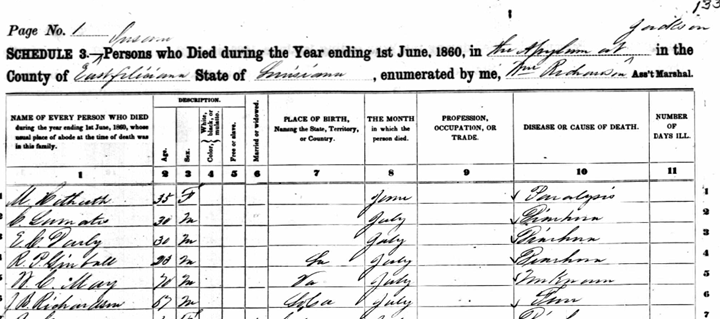
By the end of June 1860 James B. Richardson was dead from a “fever”. He died in the Louisiana State Insane Asylum in East Feliciana, Louisiana. (4)
By 1860, the Louisiana State Insane Asylum at Jackson (5)—later known as the East Louisiana State Hospital—was a young institution with grand architectural ambitions but limited resources. Built in the Greek Revival style and set on high, healthy ground, it was intended to embody the era’s optimistic “moral treatment” philosophy, offering order, fresh air, and calm surroundings. In reality, however, the asylum struggled almost from the beginning. Chronic underfunding, overcrowding, and shortages of staff and supplies meant that patients received only the most basic custodial care. Treatment consisted largely of supervision, routine, and restraint when necessary; there was little in the way of true medical intervention.
By the time James Brumfield Richardson died there the asylum housed nearly a hundred patients—more than it was designed to accommodate—and its resources were already stretched thin. While not known for the extreme abuses reported in some northern institutions, it was nonetheless a stark, under-resourced facility where the mentally ill were managed rather than treated. For James, admission to the asylum signaled that his condition was considered severe and permanent, and the care he received would have been minimal, focused on containment and basic needs rather than recovery. (6)
The final resting place of James Brumfield Richardson has never been identified, and the most likely reason is the circumstances of his death. When he died in 1859 at the Louisiana State Insane Asylum in East Feliciana Parish, institutions of that era commonly buried patients in simple, unmarked graves on asylum grounds. Records were poorly kept, and many early burial registers have been lost. Transporting a body home across state lines in midsummer was costly and difficult, and given James’s financial ruin and the strain within his family, it is unlikely that his relatives reclaimed his remains. As a result, his grave—almost certainly on the asylum property—was never marked, recorded, or preserved, leaving his exact burial place unknown today.

Works Cited
1. 1840 United States Federal Census. ancestry.com. [Online] https://www.ancestry.com/imageviewer/collections/8057/images/4409452_01077?pId=3604090.
2. Hyatt, Will posted by Juliette. Will of Martha Gaulden. ancestry.com. [Online] https://www.ancestry.com/mediaui-viewer/collection/1030/tree/163174124/person/422121229508/media/7d00431b-c682-4928-95c0-b817f854aa2b?galleryindex=4&sort=-created.
3. 1850 United States Federal Census. ancestry.com. [Online] Mississippi, Wilkinson. https://www.ancestry.com/imageviewer/collections/8054/images/4200053_00617?pId=3592698.
4. U.S., Federal Census Mortality Schedules, 1850-1885. ancestry.com. [Online] https://www.ancestry.com/imageviewer/collections/8756/images/LAT655_22-0189?pId=2058164.
5. contributors, Wikipedia. East Louisiana State Hospital. Wikipedia. [Online] https://en.wikipedia.org/w/index.php?title=East_Louisiana_State_Hospital&oldid=1303636456.
6. Asylum on Flowery Hill. 64 Parishes. [Online] https://64parishes.org/asylum-on-flowery-hill?utm_source=copilot.com.
7. Louisiana State Insane Asylum, 1907 postcard. ancestry.com. [Online] https://www.ancestry.com/mediaui-viewer/collection/1030/tree/163174124/person/422121229508/media/e9cc6670-a82a-470e-8948-1fe862814e0a?galleryindex=6&sort=-created.
8. Richard Holmes Gaulden and Susan Tullia Gaulden: Signatures. ancestry.com. [Online] https://www.ancestry.com/mediaui-viewer/tree/101846827/person/410024913034/media/bd1e9d0f-5ff7-47f3-882d-873a17819a3b.
9. Richardson-Hatfield Family Cemetery Memorials. Find a Grave. [Online] https://www.findagrave.com/cemetery/2437184/memorial-search?cemeteryName=Richardson-Hatfield+Family+Cemetery&page=1#sr-220398628.
Endnotes
[i] The 1850 Census lists:
1. James Brumfield Richardson, age 61 – He is probably buried on the Asylum Grounds.
2. Martha Mary Reily Richardson, age 57 – She is buried in the Richardson-Hatfield Family Cemetery
3. Robert Riley Richardson age 37 was born 25 January 1812 in Wilkinson, Mississippi and he died 16 March 1874 in Wilkinson, Mississippi. He married Mary Elizabeth Wells (1820-1891). They are both buried in the Richardson-Hatfield Family Cemetery.
4. Mary Elizabeth (Wells) age 30, the wife of Robert Riley Richardson. She was the daughter of Col. Samuel Willis Wells and Frances Ann Foster
5. Samuel J. Richardson age 17. He married Placidia "Mattie" Matilda Gaulden. Ann (Chivers) Gaulden willed her slaves to her children and grandchildren. Her son Richard Holmes Gaulden and his wife Susan Tullia (Richardson) Gaulden signed the court document. Samuel J. Richardson was Placidia Gaulden's husband and Susan Richardson's brother. (4)
6. John D. Richardson, age 14 – He was born 1835 and died in 1926. He is buried in the Richardson-Hatfield Family Cemetery.
7. Preston A. Richardson, age 5
8. Frances Ann Richardson, age 3
9. T.M. Richardson, age 1
The children of James Brumfield Richardson and Mary Reily were:
1. Robert Riley Richardson 1812–1874
2. Rufus Rivers Richardson 1816–1870
3. Martha Richardson 1820–1880
4. Sumpter C Richardson 1823–1770
5. Francis S "Frank" Richardson 1824–1898
6. George P Richardson 1825–1880
7. Franklin Richardson 1826–1850
8. Samuel J. Richardson 1828–1920
9. Susan Tullia Richardson 1830–1909
10. John Y. D. Richardson 1835–1926
Other members of the Richardson family, including Martha Mary Reily Richardson are buried in the Richardson-Hatfield Family Cemetery near Woodville. Internments there are: (9)
Beriah Richardson 1828 – 15 Jan 1830
Edward Everette Richardson 25 Oct 1888 – 26 Sep 1889
Francis R Richardson 1763 – 13 Dec 1820
Hester Ann Rogers Richardson 1817 – 4 Jan 1844
J. D. Richardson 1835 – Feb 1926
Margaret DuBose Richardson 1786 – 10 Jun 1827
Martha Gaulden Richardson 26 Nov 1765 – 12 Jul 1832
Martha Mary Reily Richardson 2 Feb 1795 – 1 May 1867
Mary Elizabeth Wells Richardson 7 Oct 1820 – 7 Jan 1891
Mary J. Richardson 1830 – 3 Feb 1859
Plascidia M Richardson 28 Dec 1883 – 16 Mar 1887
Robert Riley Richardson 25 Jan 1812 – 16 Mar 1874
William Arthur Richardson 1787 – 27 Nov 1823
William Arthur Richardson 1830 – 2 Jul 1834
© 2026 Catherine L. Gauldin, Gaulding Origins. All original content protected. Use of this site implies agreement with the Terms of Use and Privacy Policy.


Comments