The life of a Tenant on a large plantation like Eltham

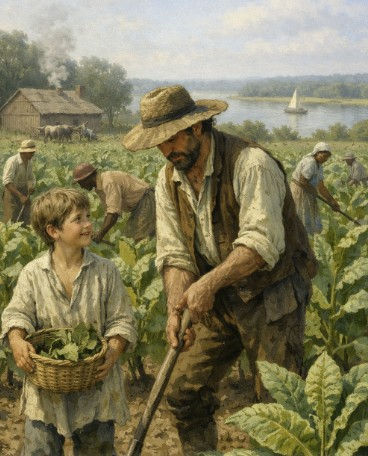
John Gaulding probably served out his indenture and lived on Eltham Plantation for the rest of his life once his indenture was over. What was his life like, and was it better than what he left behind in England. Plantations on major Tidewater rivers, like Eltham on the Pamunkey River followed a remarkably consistent spatial logic. Even though Eltham’s own records and plans were destroyed, we can reconstruct its layout with high confidence because Tidewater plantation design was standardized among elite families such as the Bassetts, Burwells, and Randolphs.
Below is a clear, historically grounded reconstruction of what a plantation like Eltham would have looked like in the early 1700s, based on archaeological studies, comparable plantations, and Tidewater architectural norms. (1)
⭐ 1. The Core Principle: Everything Oriented Toward the River
On a major waterway like the Pamunkey, the river was the highway, not the roads. This means the main house faced the river, not the inland road. The landing, wharf and warehouse were directly below the house and the plantation’s ‘front door” was the river. This is the single most important fact for understanding the layout. (2)
⭐ 2. The Main House: High Ground, River-Facing, Dominant Position
The great house at Eltham (a large brick Georgian mansion) would have been placed on the highest available rise overlooking the Pamunkey. I had a long, straight approach from the inland road, with a broad lawn or avenue sloping down toward the river landing. This elevated position displayed wealth, protected the house from flooding and allowed William Bassett to visually command the estate. Comparable examples are Westover, Shirley, Rosewell and Carter’s Grove. Eltham was described as having a 150-food façade, so it was among the grandest.
⭐ 3. The “Inner Yard”: Outbuildings Closest to the House
Behind or beside the main house was a cluster of essential structures, usually arranged symmetrically. The Kitchen, which was always detached due to fire risk, the Dairy, Smokehouse, Laundry or Wash House, the Meat house and Well house and the Garden enclosures were located here. These buildings formed the domestic core of the plantation. They were close enough for daily use but far enough to keep heat, noise, and smells away from the main house.
⭐ 4. The “Work Yard”: Skilled Labor and Storage Buildings
A bit farther from the house, and often screened by trees or fences, were the work buildings. They included the Carpenter’s shop, Blacksmith shop, Stable and carriage house, Granary, Corncribs, Barns and Tool sheds. This is where a carpenter like Thomas Edwards, Samuel Gaulding’s master, would have worked.
⭐ 5. The Wharf and Riverfront Zone
Directly below the main house was the Wharf and Landing on the river. There would have been a Warehouse used for tobacco inspection, a Boat house or skiff shelter and various fishery structures. This was the economic engine of the plantation. Tobacco hogsheads were rolled down from the curing barns to the landing for export.
⭐ 6. Slave Quarters and Tenant Houses: Always Set Apart
These were never near the main house. They were place downwind and out of sight from the formal approach. They were situated near the fields and not the mansion with houses often in rows or clusters. For a plantation the size of Eltham, there would have been multiple clusters of enslaved quarters with separate quarters for skilled enslaved workers. The Tenant or Overseer houses were on the plantation’s outer edges. Tenant houses where a family like the Gauldings may have lived in were typically one to two miles from the main house and near the field system where they worked. It was probably a simple timber structure of one to two rooms and was placed along a minor road or path. This distance preserved the social hierarchy and kept the plantation’s formal core visually pristine. (3)
⭐ 7. Fields, Orchards, and Pastures
Surrounding the work yards and quarters were:
Tobacco fields (closest to the river for easy transport) - Tobacco fields were rotated frequently, so the landscape was constantly shifting.
Cornfields (farther out)
Orchards (often behind the house)
Pastures (on the plantation’s periphery)
How This Applies to the Gauldings
Given the layout:
The Gauldings, as landless tenants or laborers, would have lived far from the main house, near the fields.
Their home would have been simple, likely a one‑room or hall‑and‑parlor structure.
They would have been within walking distance of the work yards but not within sight of the mansion.
Their daily world was the fields, work yards, and parish, not the formal plantation core.
This matches the social and economic structure of early 1700s New Kent. (4)
John Gaulding must have had a difficult life. The work was hard on a plantation like Eltham, but it was more difficult for the enslaved people who worked side by side with him. There was a very real and very significant social difference between enslaved people working on a large plantation and tenant farmers like the Gauldings. It’s important to explain that difference carefully and accurately, because the two groups lived physically close yet occupied entirely different social worlds.
Below is a clear, historically grounded explanation that fits the early‑1700s Tidewater context of Eltham Plantation.
⭐ 1. Legal Status: The Deepest Divide
Enslaved people were legally considered property, not persons under the law. They could not own land, enter contracts, or move freely. Their status was hereditary — children inherited enslavement from their mother and they had no legal right to family integrity. Marriages were not recognized by law. (5)
Tenant farmers on the other hand were free people, even if they were poor. They could own property, sign contracts, sue and be sued. They could move where they wanted to, negotiate wages and choose employers. Their marriages and families were legally recognized and this legal distinction shaped every other aspect of life.
⭐ 2. Social Hierarchy on a Large Plantation
Plantations like Eltham had a strict social order, roughly:
Planter elite (Bassett family)
Overseers and skilled white workers
Tenant farmers / indentured servants
Enslaved skilled laborers
Enslaved field laborers
Tenant farmers were above enslaved people in legal and social status, but below the overseer class and far below the planter elite. (6)
⭐ 3. Daily Life: Overlapping but Unequal
Tenant farmers worked long days but they had some autonomy. They could cultivate small gardens, raise animals, and keep part of their crop. They lived in their own households with their families and they could aspire to land ownership, although many never achieved it. Enslaved people worked under coercion with no legal right to refuse. They had no control over their labor, housing or family stability. They lived in quarters that were assigned to them by the plantation and they faced punishment, sale or forced separation. Even when they worked side by side, the lives of these two groups of people were fundamentally different.
⭐ 4. Housing and Physical Separation
On a plantation like Eltham the tenant houses were located on the outer edges of the estate. They were simple but independent dwellings and they represented a household that had some autonomy. The Enslaved quarters were clustered in rows or small villages close to the fields or work yards. They were under constant supervision and this physical layout reinforced the social hierarchy.
⭐ 5. Economic Status
Tenant farmers paid rent through labor or crop share. (4) They could accumulate modest personal property and had the possibility of upward mobility. Enslaved people could not legally own property and all economic value they produced belonged to the master. Upward mobility was structurally impossible.
⭐ 6. Community and Culture
Despite the hierarchy, there were points of human contact between the two groups. Children sometimes played together in early childhood and tenant farmers and enslaved people often worked in the same fields. They shared knowledge of crops, weather, and survival, but the social distance remained enormous because the law enforced it. (6)
Here is a narrative scene of what daily life would have felt like for the Gaulding family living as tenant laborers on Eltham Plantation in the early 1700s.
🌾 A Day in the Life of the Gauldings at Eltham Plantation (ca. 1710–1720)
The first light of morning crept over the Pamunkey River, turning the mist above the water into a pale silver veil. In the small tenant house near the edge of the tobacco fields, John Gaulding was already awake. He had learned long ago that the plantation’s rhythm was not set by clocks but by the sun, the seasons, and the demands of the crop.
Their house—a simple hall‑and‑parlor structure of rough timber, daubed with clay—sat a mile or more from the grand Bassett mansion. From the Gauldings’ doorway, the great house could not be seen at all; only the faint line of smoke rising from its distant chimneys hinted at its presence. The Gauldings lived in the working world of the plantation, not the formal one.
Inside, Anne (Steward) Gaulding stirred the embers in the hearth, coaxing them back to life. The smell of woodsmoke mixed with the damp scent of the river bottom. She set a small pot of cornmeal mush to warm while their children—Samuel, Sarah, and the younger ones—rubbed sleep from their eyes.
Outside, the plantation was already waking. From the direction of the work yard came the rhythmic clink of a blacksmith’s hammer, and farther off, the lowing of cattle being driven toward the pasture. A pair of enslaved boys hurried past the Gauldings’ house, carrying tools toward the carpenter’s shop. Their bare feet made soft thuds in the dew‑wet grass. John stepped outside, stretching stiff muscles. The tobacco plants, tall and broad‑leafed, stood in long rows that followed the curve of the land toward the river. Today would be a day of worming and topping, the tedious but essential work that determined the quality of the crop. The overseer would ride through soon, checking each laborer’s progress.
Anne handed John a small wooden cup of water and a heel of coarse bread. There was no time for more. Tenant families like the Gauldings lived by a simple truth: the plantation’s needs came first. By mid‑morning, the sun was already hot. John and Samuel worked side by side, fingers stained green from pinching the suckers off the tobacco stalks. Samuel, not yet ten, tried to match his father’s pace. He knew that every task he learned now would shape his future—whether as a hired hand, a tenant, or, if fortune allowed, a small landholder someday.
From the river came the creak of a wagon and the rumble of rolling hogsheads. Enslaved men were hauling the heavy barrels toward the wharf, where a small sloop waited to carry them downriver. The smell of tar, rope, and river mud drifted on the breeze. At midday, the Gauldings paused for a brief meal—cold mush, a bit of salt pork, and water dipped from a nearby spring. They sat in the shade of a sycamore, watching dragonflies skim the surface of a drainage ditch. The plantation stretched around them in every direction: fields, work yards, quarters, barns, and the distant, unseen world of the great house. In the afternoon, Anne and Sarah tended the small kitchen garden behind their house—beans, squash, and a few herbs. They checked the snares John had set near the woods and gathered firewood for the evening. Life for tenant families was a constant balance between plantation labor and their own survival.
As the sun dipped low, the overseer finally dismissed the field hands. John and Samuel walked home slowly, shoulders aching, clothes streaked with dust and sap. The air cooled, carrying the scent of the river and the faint sound of a fiddle from the enslaved quarters farther down the lane. Inside the Gaulding house, Anne ladled out a thin stew. The children crowded close to the hearth, their faces warm in the firelight. John sat on the low bench, rubbing his hands together, feeling the grit of the day in every crease of his skin. Outside, the plantation settled into night. The great house on the hill glowed faintly with candlelight, but here in the tenant quarter, darkness came quickly. Crickets sang. A whip‑poor‑will called from the woods.
John looked at his family—tired, hungry, but safe—and felt the quiet resolve that had carried him from England to this place. Tomorrow would be the same: fields, labor, the river, the overseer, the endless rhythm of tobacco. But it was a life, and it was theirs. And in the flickering firelight, young Samuel watched his father’s hands and wondered what his own future on this vast plantation might become.
Works Cited
1. Pallante, Martha Irene. The Development of Building Patterns in Tidewater Virginia, 1620–1670. William & Mary ScholarWorks. [Online] https://scholarworks.wm.edu/etd/1539625190.
2. List of James River Plantations. Wikipedia. [Online] https://en.wikipedia.org/wiki/List_of_James_River_plantations.
3. Plantation Layout. National Park Service. [Online] US Department of the Interior. https://www.nps.gov/subjects/slavery/plantation-life.htm.
4. Tenancy in Virginia. Colonial Williamsburg Foundation. [Online] https://research.colonialwilliamsburg.org/Foundation/journal/Autumn01/tenants.cfm.
5. Slavery and the Law. National Park Service. [Online] https://www.nps.gov/articles/000/slavery-and-the-law.htm.
6. Life in the Plantation South. U.S. History. [Online] https://www.ushistory.org/us/5e.asp.


Comments